“The most regretful people on earth are those who felt the call to creative work, who felt their own creative power restive & uprising, and gave to it neither power nor time” Mary Oliver
Read MoreAnswer the call to create...have no regrets!

“The most regretful people on earth are those who felt the call to creative work, who felt their own creative power restive & uprising, and gave to it neither power nor time” Mary Oliver
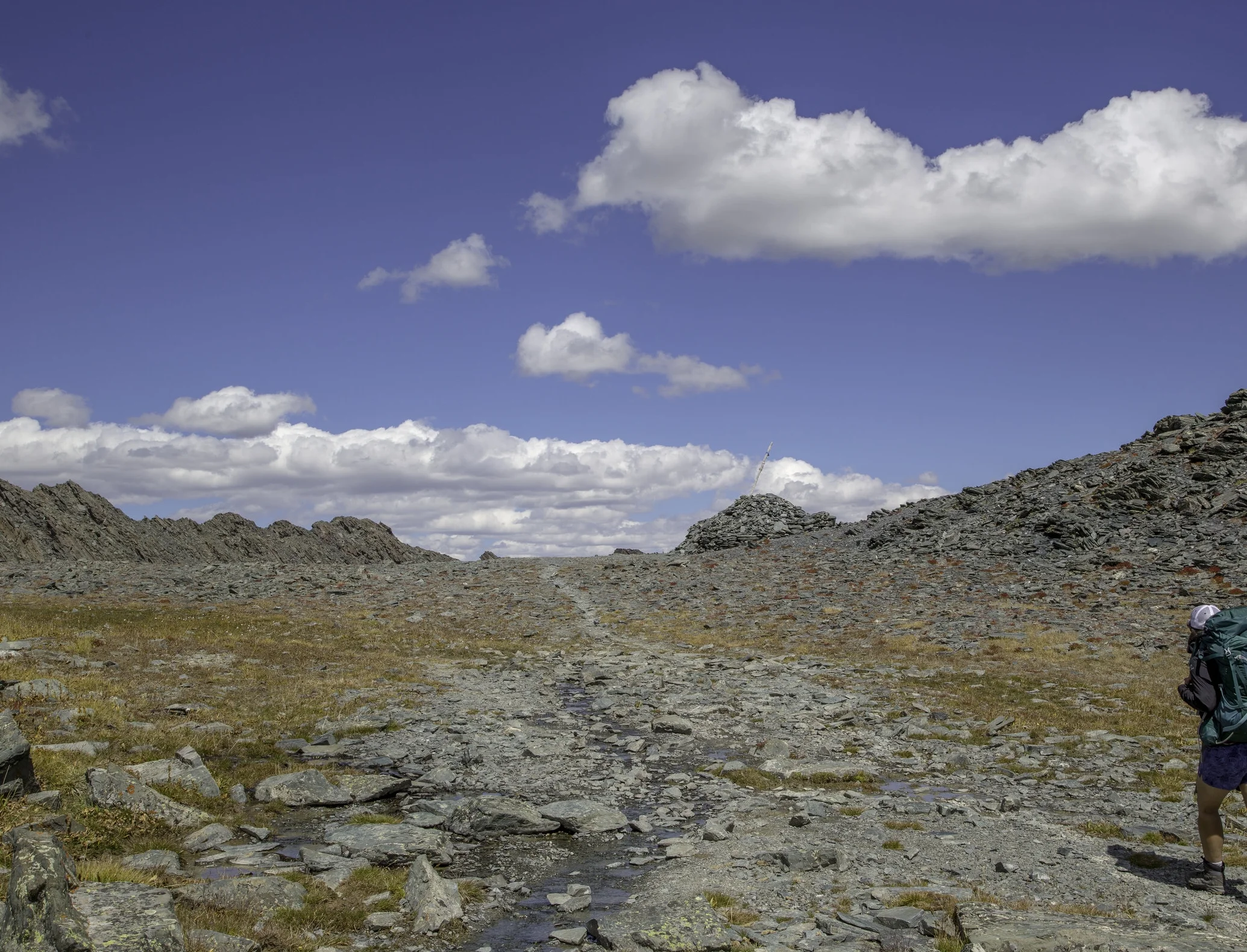
Read MoreWe were surprised to look out of the tent on our last morning and see the ground covered in snow; it was cold too. We took our time making breakfast, boiling water several times for repeat cups of coffee, staying in our sleeping bags as long as possible!
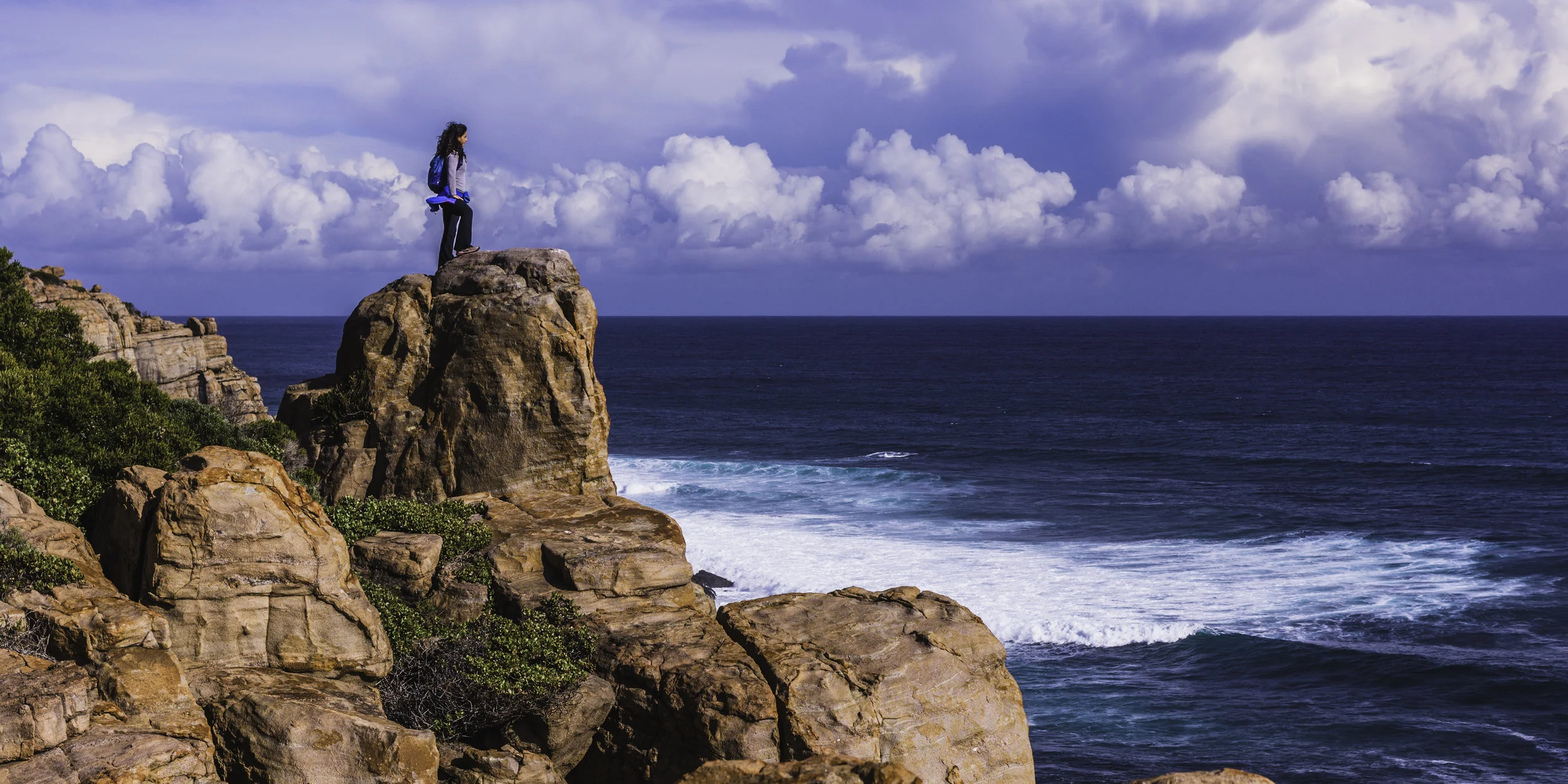
Read MoreWhen I walked in the Fitzgerald River National Park (FRNP) for the first time, I didn’t know much about it at all. I didn’t know that it was home to almost 20% of WA’s plant species; I didn’t know that it was a UNESCO listed biodiversity biosphere and a natural treasure; I didn’t know that the Ravensthorpe Wildflower Show attracted thousands of visitors from all around the world during its annual two-week event in September; but most of all, I didn’t know that it was going to blow me away!
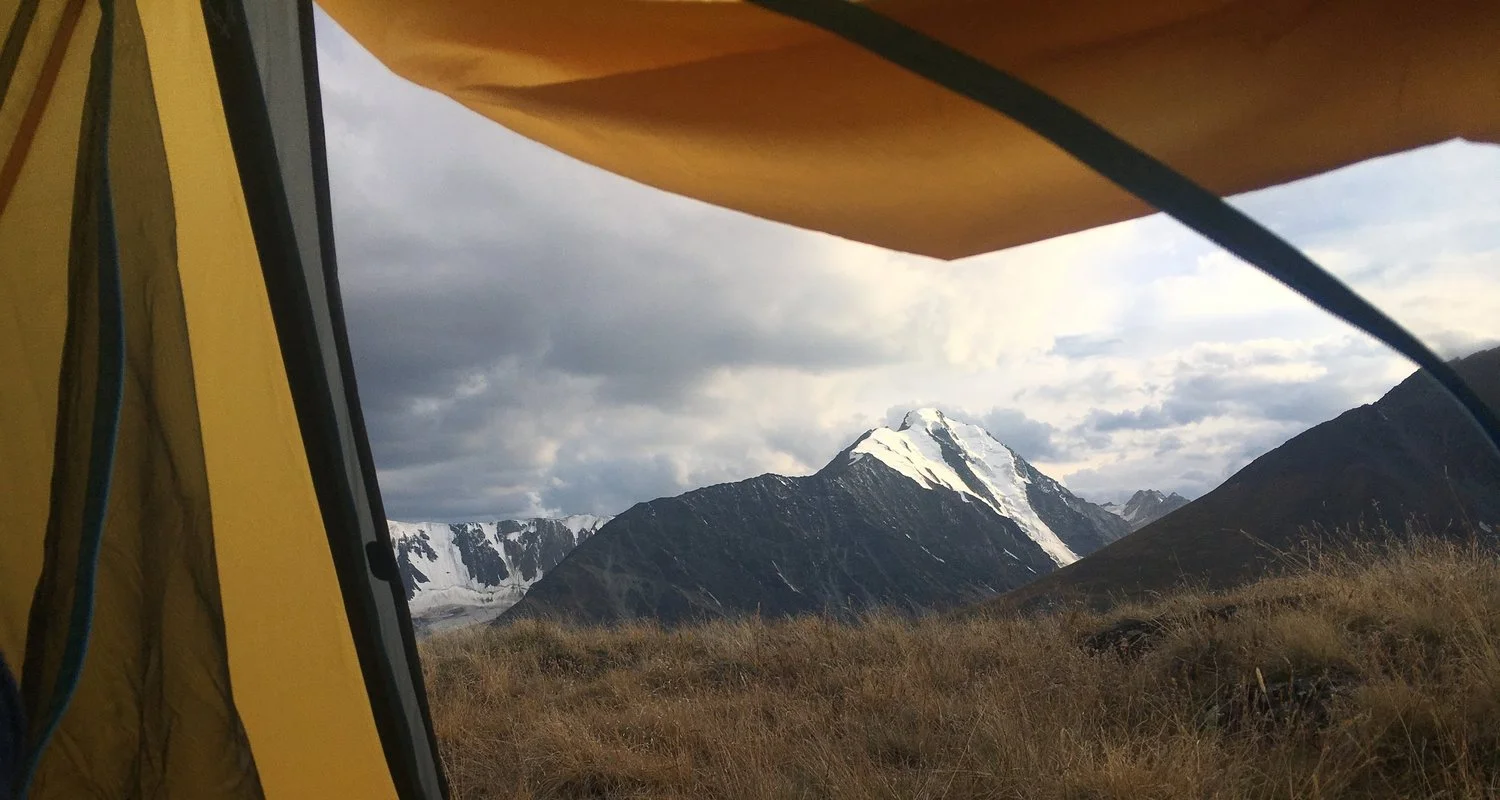
Read MoreWaking up to the 180 degree view of the five sacred peaks - Nairamdal, Burged, Ulgii, Malchin, Khuiten and the Potanin Glacier below - was one of those moments that gets etched in the mind to be recalled many times over, years after it has passed. It was a moment that held power, mystery and beauty.
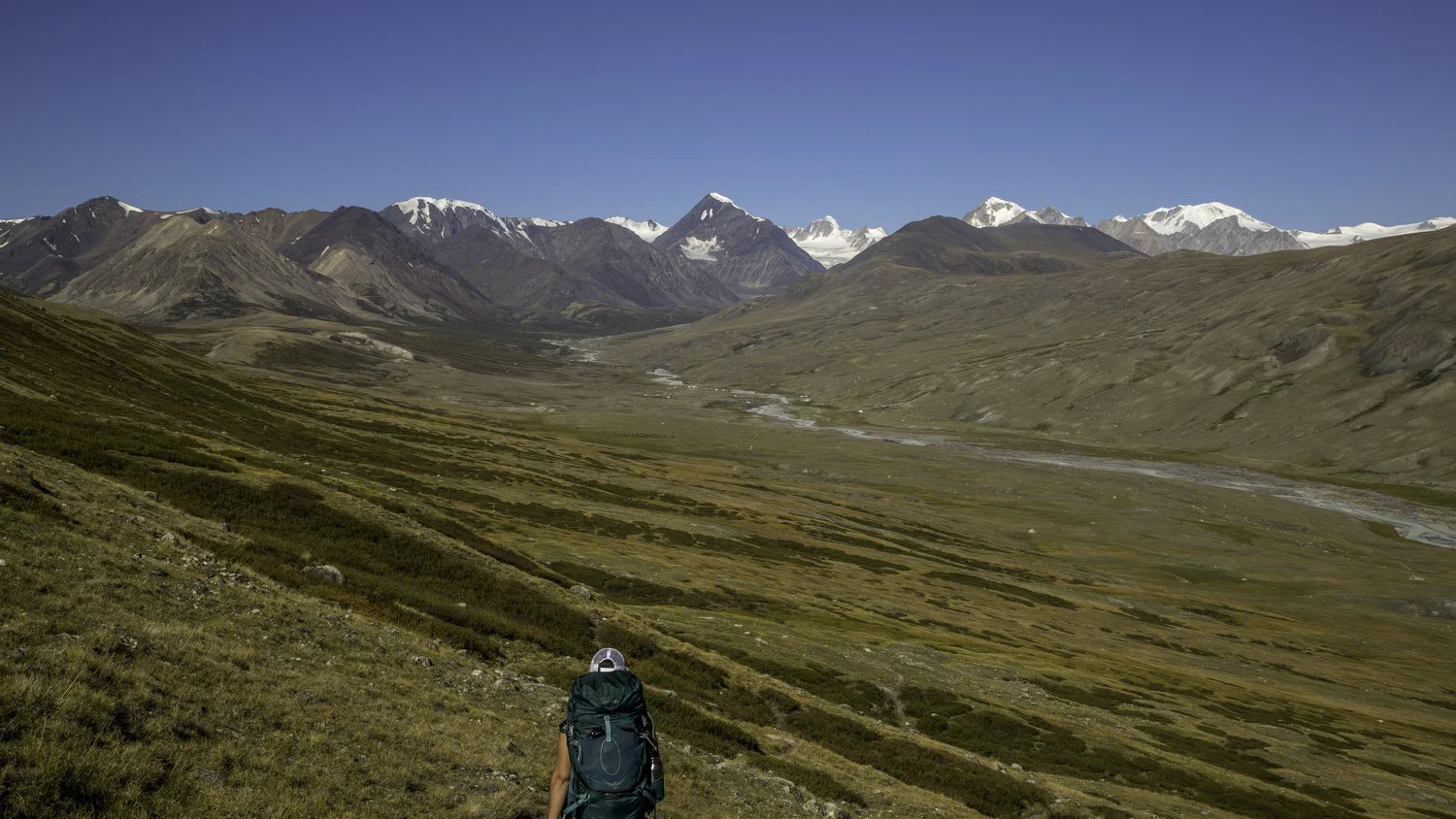
Read MoreAfter brekky we continued walking under the bold and vivid blue of the sky, over the summer green & yellow hues of the grassy slopes and with the murmur of the distant river in our ears. Occasionally, a rabbit, a marmot or a land squirrel would scamper in front of us, looking for their underground shelter; wildflowers abounded.
Read More
Milky Way & Emu in the Sky over Wilyabrup Cliffs during Edgewalkers Walking & Creativity Night Photography Retreat, 2017 - taken by Donna Wolter
“What can I do, when the night comes and I break into stars? Nayyirah Waheed
Standing under the vastness a clear, star-filled sky can be profound and moving. Our desires, concerns, activities; our perspectives about human existence suddenly shifts and most of us are filled with nothing less than awe.
For centuries humans have studied, charted and tried to understand the vast and dark mystery that is the night sky.
Read MoreYou’ve taken the steps to doing something you love and set some big goals in your life. You have stepped out of your comfort zone and challenged yourself by taking a sculpting or drawing class, registering a business name; you have been getting up early and working on your autobiographical novel or swimming at the beach every morning...maybe you have even joined one of our Edgewalkers Creativity & Walking Retreats. Great!
You have moved out of dreaming, planning, maybe procrastinating...and into action!
Enthusiasm is rampant at the start; the possibilities of living more creatively, more connected to your body & nature and with more energy and self-expression are exciting and motivating. However, if you are anything like me, staying in the zone can be a challenge.
Here are 5 things that I know help me sustain my enthusiasm when it slackens, maintain my focus when it diverts and keep me loving the life I create daily when I doubt my choices.
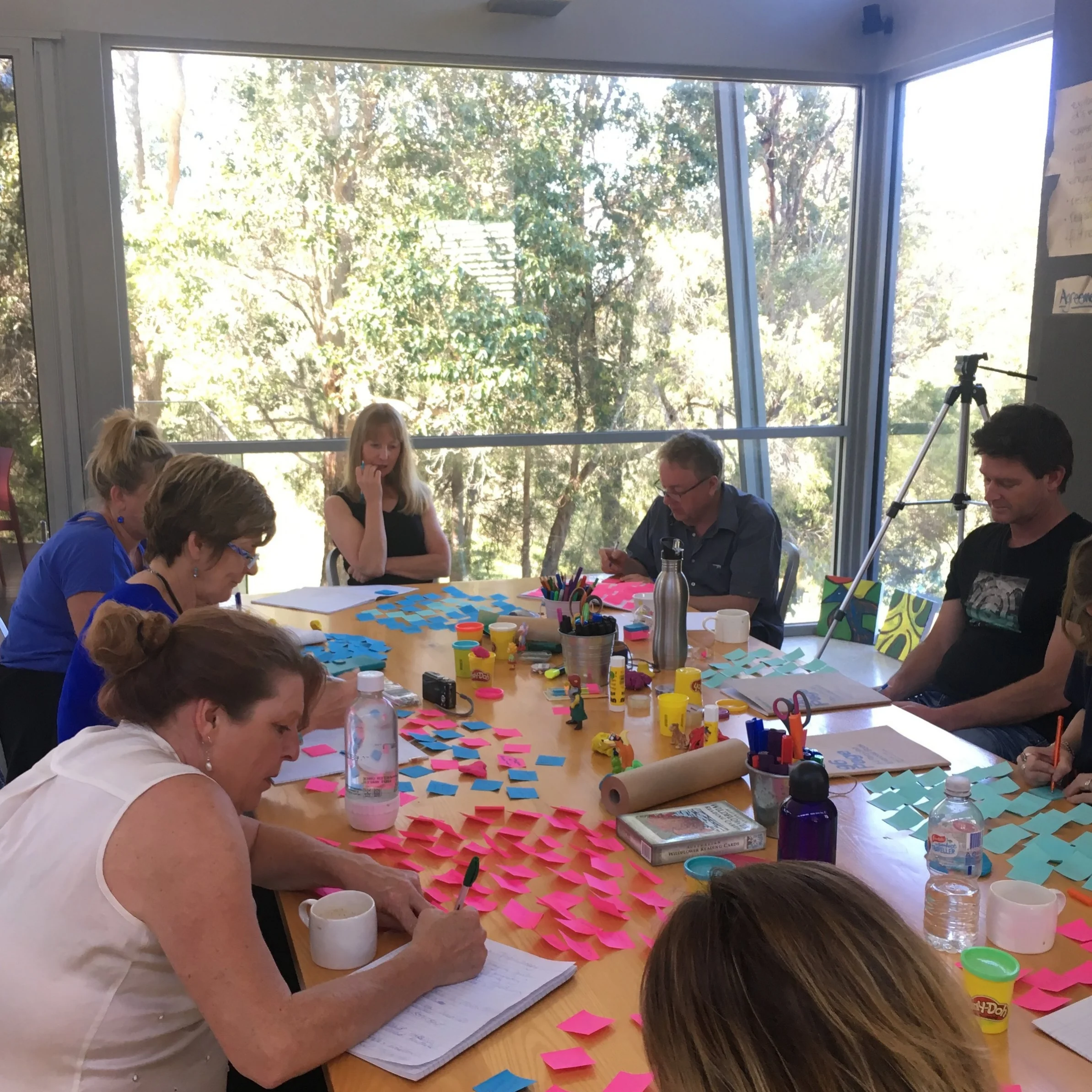
Creativity & Walking Retreat 2017 - Margaret River, Western Australia
“Creativity is a habit, and the best creativity is a result of good work habits.” Twyla Tharp
I know that sounds counter-intuitive because we grow up with the notion that creativity is something that is inspired by a muse or suddenly happens to specially gifted and talented people. Or as Tharp puts it 'we think creativity is a way of keeping everything fresh and new, while habit implies routine and repetition.' But anything that we want to become good at requires practice. Even the most talented of athletes or musicians will invest tens of thousands of hours on repetitive tasks just to make them second nature.
For the last two months I have been rekindling a yoga practice. Why? It's good for me: my moods are better, my body feels alive, my head is clearer and kinder and softer; quieter, less neurotic. And, in relation to my business and the life I am living and creating, it gives me the focus & strength to hold a large space for it all to manifest and take place in.
So here's how I am creating the habit: I just SHOW UP. Every day. Don't worry about whether you write a lot, walk enough kilometres, paint with the right colours or hit the right notes; don't worry about whether you've got the right workspace or studio or business model; just show up; because once you show up, as YogaLab owner & teacher Shawn Taylor, reminds us every day, the hardest part is over.
Show up enough times so the blank page will no longer be terrifying; enough times so that your fingers don't hurt across the guitar strings; enough times so that you generate enough income to call yourself a business, show up until, as my performance specialist friend Julie Meek calls it, the habit is 'non-negotiable'.
I have other habits that serve me well. I write every day. I walk every day. And now, at least five times a week, I show up on the mat.
I tramp a perpetual journey - Walt Whitman
I have a big vision for Edgewalkers. I want Edgewalkers to grow into a successful, international company that plays a role in bringing people closer to nature and to their most creative, self-expressive & adventurous selves. In addition, I want to continue to conduct community & organisational development through theatre-based, transformative & creative approaches to tackle difficult issues all over Australia and the world. And, I want to continue creating both academic and popular content about it all. And...(breath) I want go on a long hiking adventure every year.
Right now, I could basically be working all day & night to do everything I want to do! There is always content to write, improvements to make on the website, on our marketing; there is always social media to post, networks to build, clients to contact, writing to edit, new tracks to walk, packages to sell. It is endless. For me acknowledging each small goal at a time reminds me that although there is a long 'to do list' I am on track and present.
Acknowledge your small wins with marked actions and small celebrations. When you make that difficult phone call; when you run all the way up the hill without a break; when you pay one more instalment of your epic holiday...or when you simply turn up daily. Record it somewhere. Reflect on it. Rejoice deep inside and...be grateful.
Thank yourself and everything that has conspired to come together as a result of your intention and each little action you have taken to get to where you are. I like to burn candles as gestures of gratitude and accomplishment. If that is too hippy for you, then do something more transactional and buy yourself movie tickets, or get your hair done, or have some chocolate.
I also use a whiteboard (I'm a hippy with attitude) where I jot weekly goals (usually I just change the dates and some of items on the list remain the same) and as I move through them I cross them off with different coloured pens! At the end of the week I have a colourful testament to me being absolutely on track to my bigger vision.
Despite all of this, I still have to remind myself daily to listen to my own advice because like everyone else, I can so easily get bogged down in fear, impatience & stress...I find this as difficult as you do.
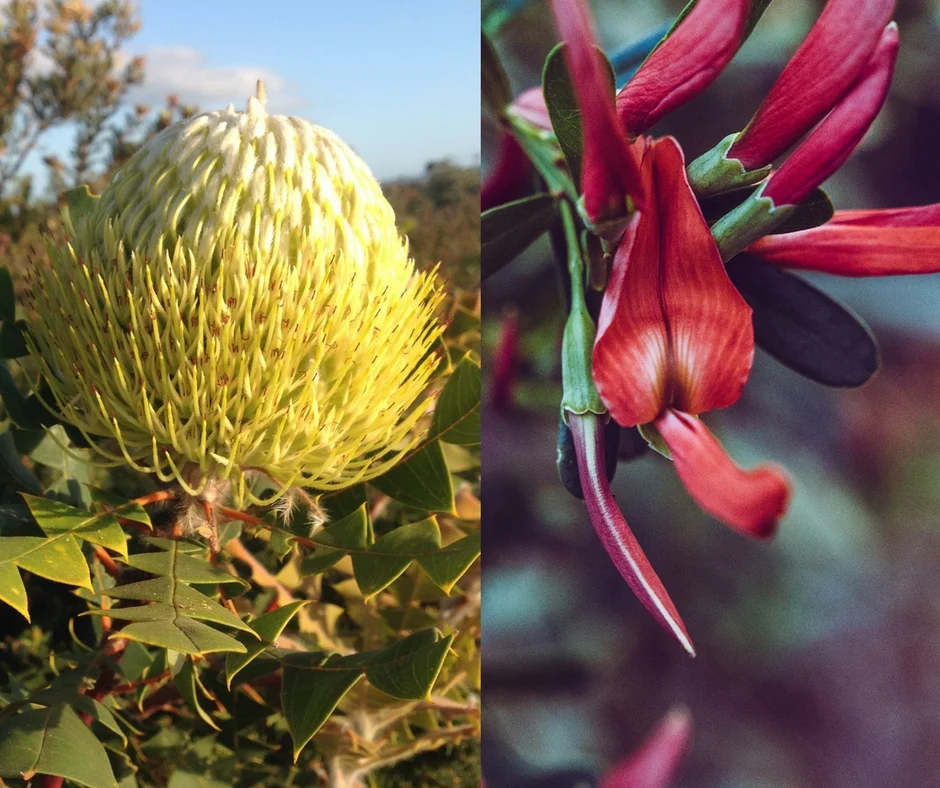
"A flower does not think of competing with the flower next to it. It just blooms' Zen Shin
Don’t compare yourself to others. ‘Yeah, yeah’ I can hear your cynic saying, you’ve heard that before; well hear it again! You are unique. We all are. Comparing ourselves to others is a sure way to lose motivation. There are going to be people who have already run a marathon, published a book (or two), won photography prizes, established successful businesses or climbed Mt Kilimanjaro; there are people who swim faster, jump higher and will always look better than you in a bikini. Get over it! Shift your perception to where YOU are right now and how wonderful that is. Be inspired by what others are doing, rejoice in their achievements but remain focused on your own unique goals.
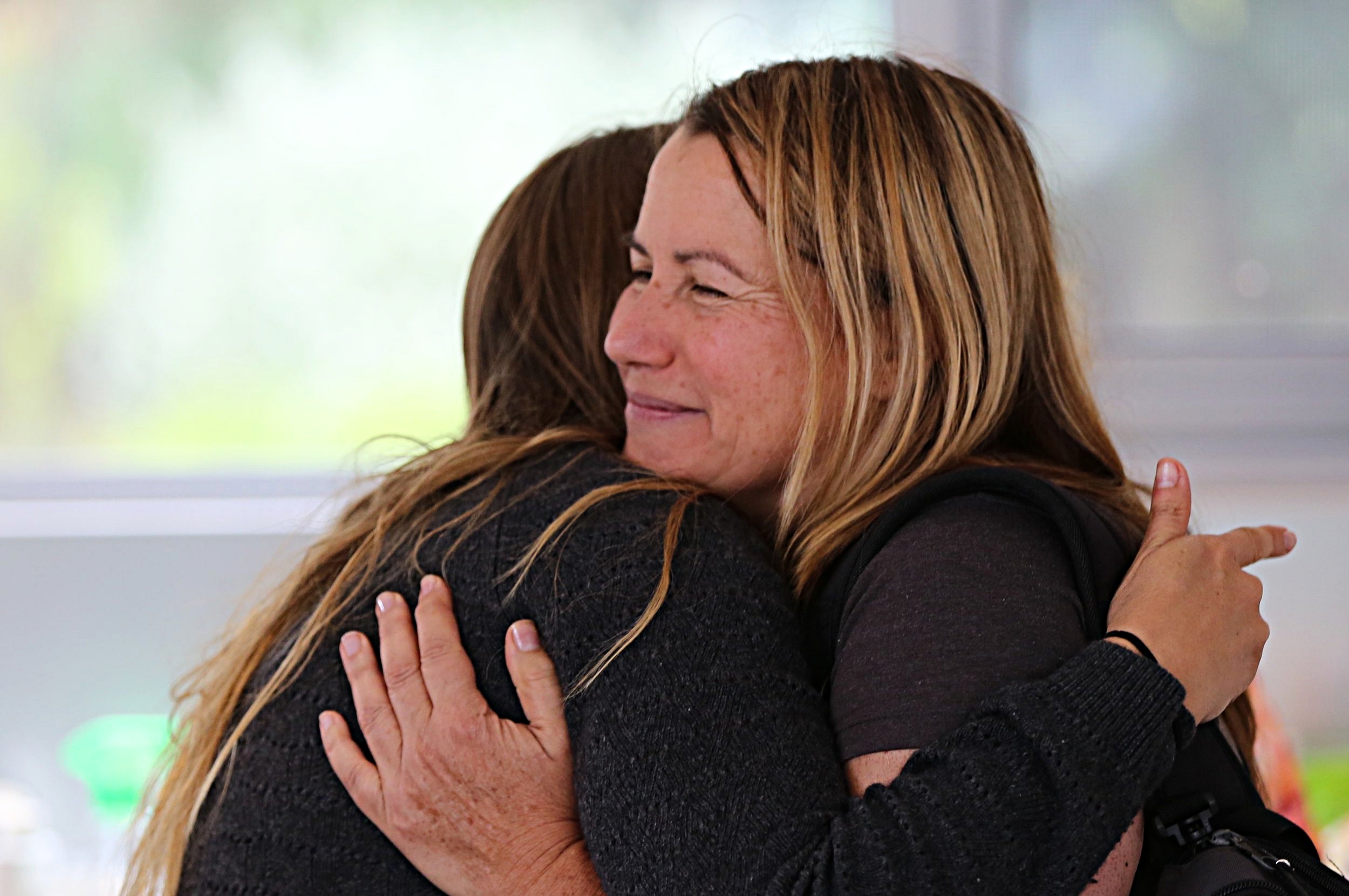
When it is clear you are amongst like-minded people - Creativity & Walking Retreat April 2016
"you are a sea of light. open your eyes. see yourself' Nayyirah Waheed
Firstly, surround yourself with your own inspiration. Allocate a certain amount of time a day to read, watch, listen or do what you know inspires you. It does not have to be long or complicated.
I am a staunch Morning Pages advocate, even though I had always kept a journal beforehand, I have been doing Morning Pages since I first read Julia Cameron's The Artist's Way in 1999. Three pages of unadulterated, stream-of-consciousness writing that allows my mind to empty out concerns & insecurities as well as motivate & show me a way through difficulties. They are like a meditation. As Cameron puts it:
"in Morning Pages ...we pull ourselves inward to the core of our true values, perceptions, and agendas...it is a form of meditation, a particularly potent and freeing form ...our worries, fantasies, anxieties, hopes, dreams, concerns and convictions all float freely across the page. The page becomes a screen for our consciousness. Our thoughts are like clouds crossing before the mountain of our observing eye."
The Morning Pages take me fifteen to thirty minutes and; every time, they slow me right down and help me start my day more connected to myself and why I am doing what I am doing.
Secondly, surround yourself with the inspiration of others. Be around people who leave you expanded and excited about life and what you are doing & what they are doing; people who leave you feeling lighter and brighter. You know who these people are; they are interested in what you say to them, they see the light and the value of what you are doing. Surround yourself with people who may not be coming along with you but encourage you on your unique adventure.
This also means staying far, far away from people who, for whatever reason, do not or cannot support or encourage you. Cameron calls them 'poisonous playmates'. Maybe it's because our new direction threatens them. Maybe it's because they do not have the imagination or the courage to step into their own self-expression and dreams. Whatever the reasons, we have to stay away from their doubts & criticism to protect our newly found creativity & direction.
"Walking allows us to be in our bodies and in the world without being made busy by them' Rebecca Solnit
I cannot stress how important walking regularly has been for me in generating ideas, problem solving, reflecting, analysing, and in effect, dealing head on with everything that life throws at me on this mysterious journey of life, love and creating.
I have learnt to simply & unceremoniously, put on my shoes, grab my keys and just step outside the front door when I'm spinning my wheels at my desk or when my thinking keeps sinking me deeper into a problem instead of out of it. I have learnt to block out a half day to to regularly go for a longer walk; to spend a few hours in a quiet nature track somewhere to get clarity and direction amongst trees and flowers.
For me staying motivated is a daily, long-term task that requires a concerted effort so that I can habitually make choices that support me every step of this journey and help me hold my vision & create it.
I hope you find something useful & encouraging in what I have shared and that it helps you stay on track!! If you want to stay connected to a group of like-minded people more informally join our Edgewalkers Facebook Group and support each other on this journey of creativity & self-expression.
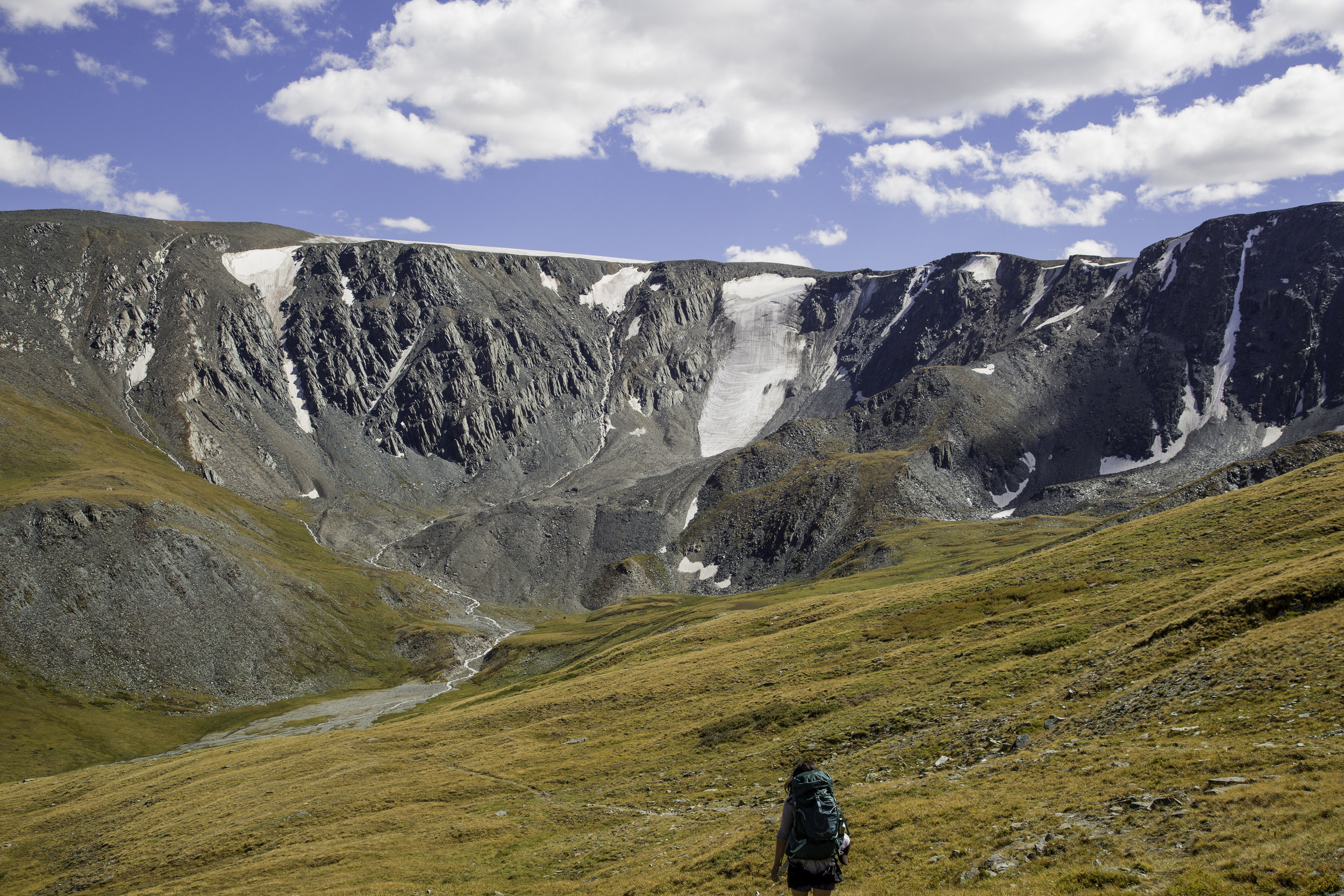
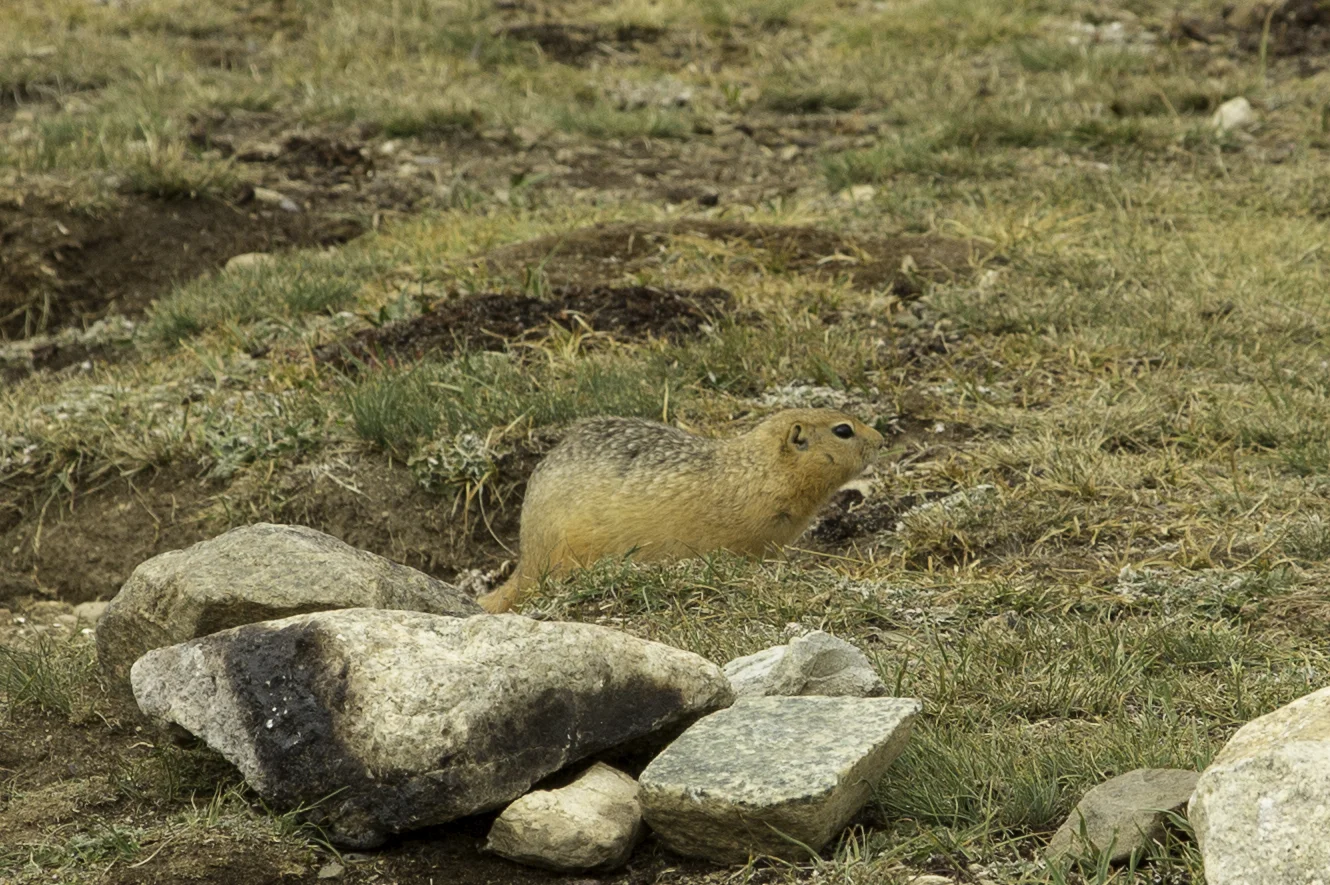
What a sublime view to wake up to and what the photo cannot convey is the tranquil sound of the brook whispering beside us. That morning we saw Mongolian mountain goats (Capra sibirica) but were not quick enough to capture them on photos. We captured this shot of a land squirrel though.
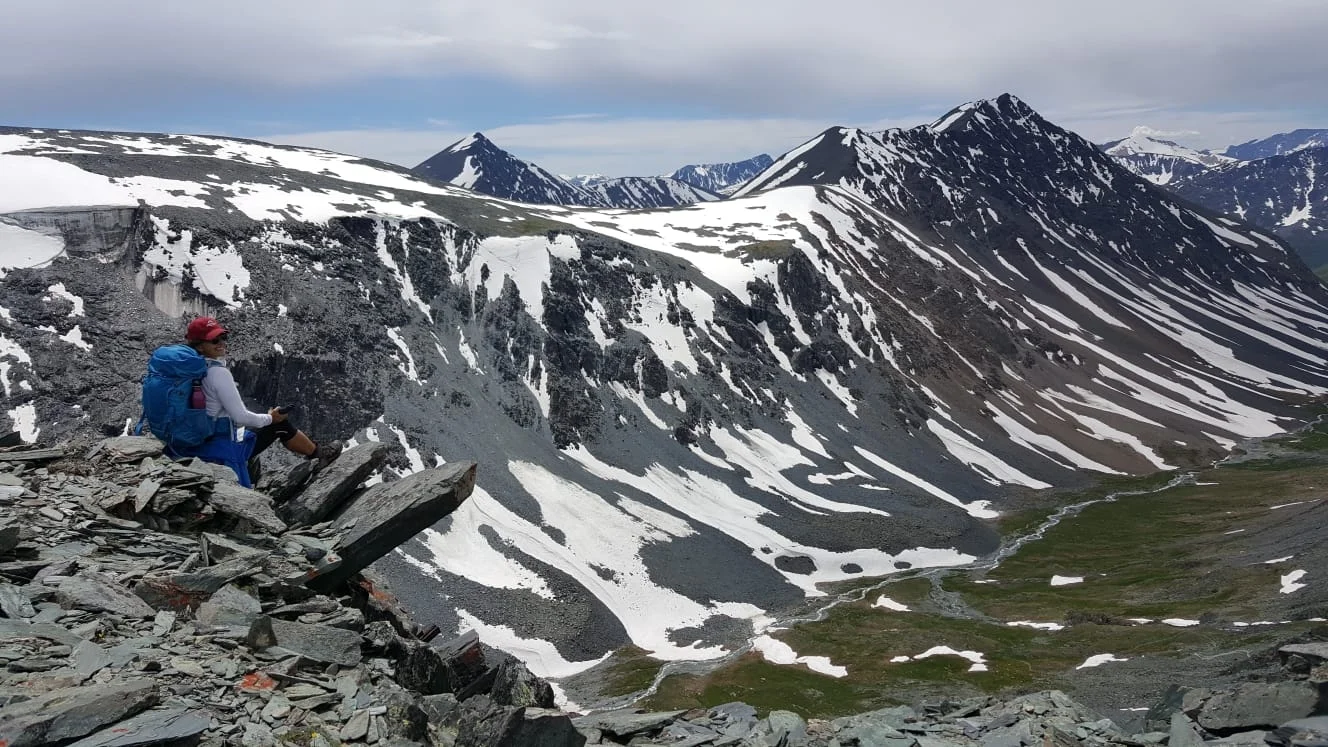
Our lunch of two-minute noodles never tasted so good as today after the effort to reach the 3,400-metre pass, sitting on chunks of black and grey slate, the sharp chilly wind offsetting the bright, warm sun, surrounded by 360 degree views of the top of several peaks and smaller glaciers. See video below.

Before descending into the Khar Salaa valley, we were overtaken by a pack of speeding camels loaded with gear. This was a breathtaking and very dramatic section of walking, senses on overload from every direction.
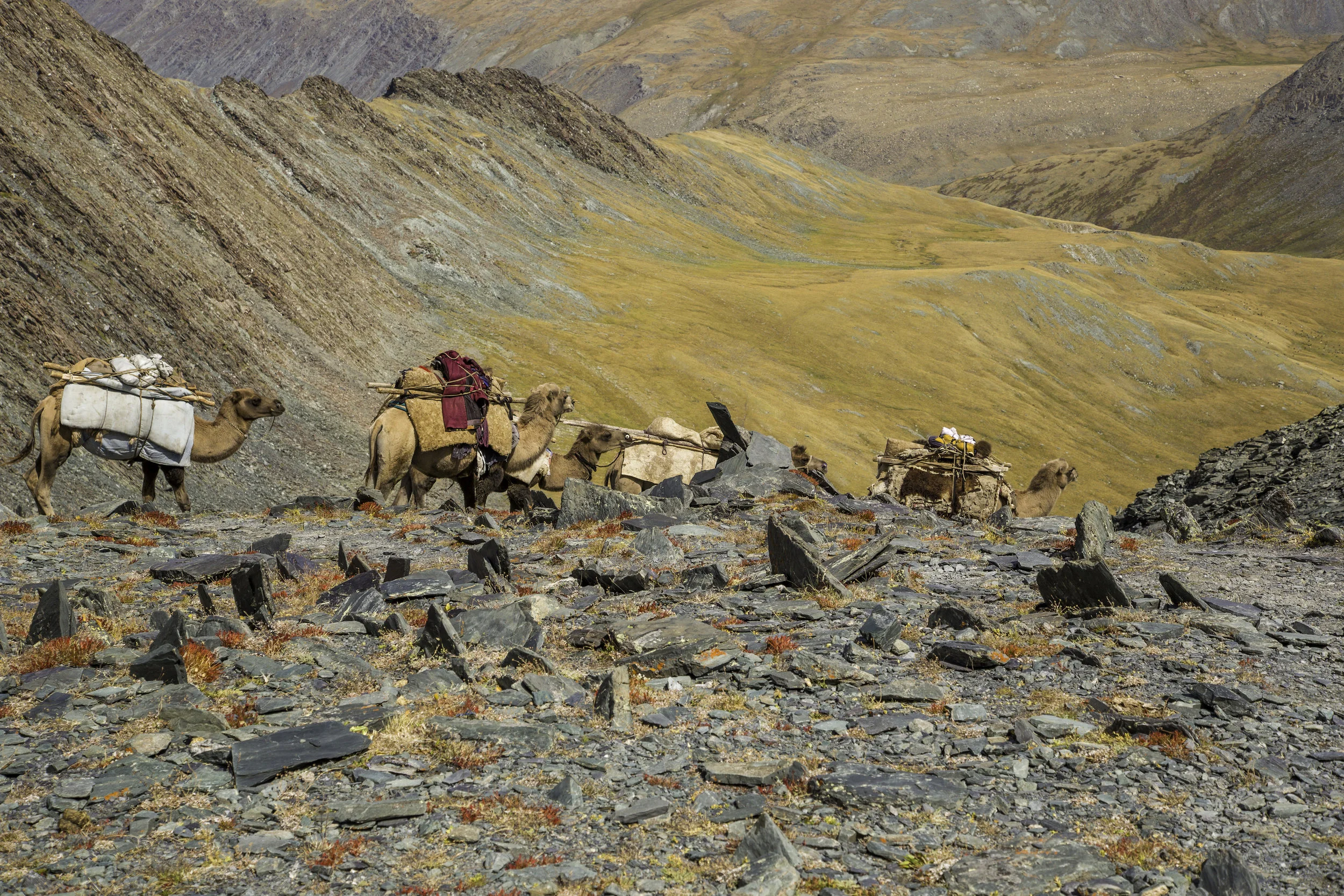
All around were mountain edges, ‘tobo’ shrines, the river flowing in the distance, glaciers, changing terrain & wildflowers.
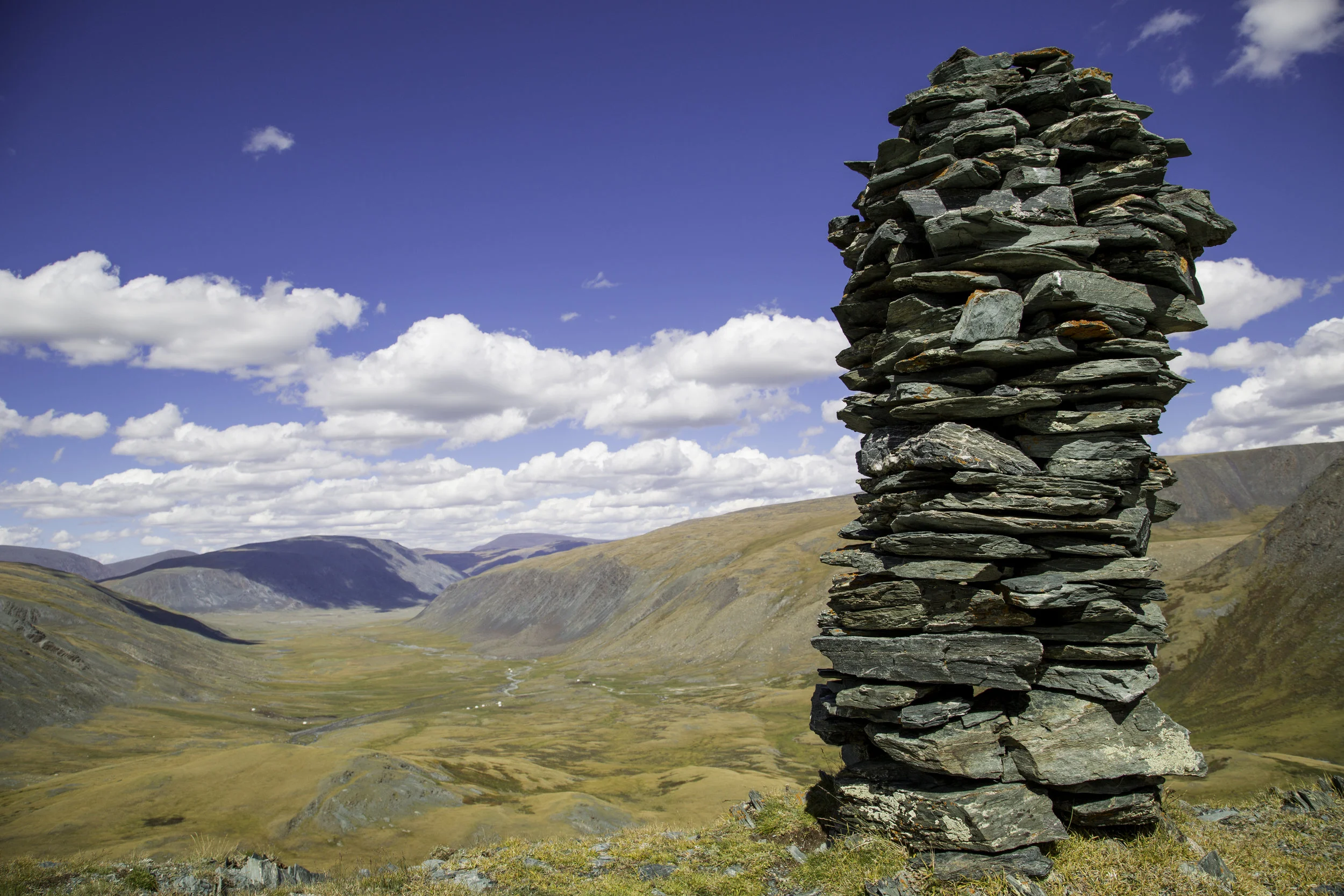

As we descended to the valley, the activities of nomadic Tuvan herders captivated our attention while we rested and figured out a way to get across the large boggy stretch up ahead.

The end of summer signals a time to prepare for the harsh Mongolian winter. At the camp ground some nomads were occupied with fixing a truck, others were checking on the drying goat skins spread like offerings outside a ger.

Further afield, a team of men and women were finishing a day of grass cutting (using scythes) and packing it tight into back of a truck.

Tavan Bogd National Park - Nomads preparing for winter
Finally, two girls signalled to us to follow them and showed us a way to hop over the streams and waterways.
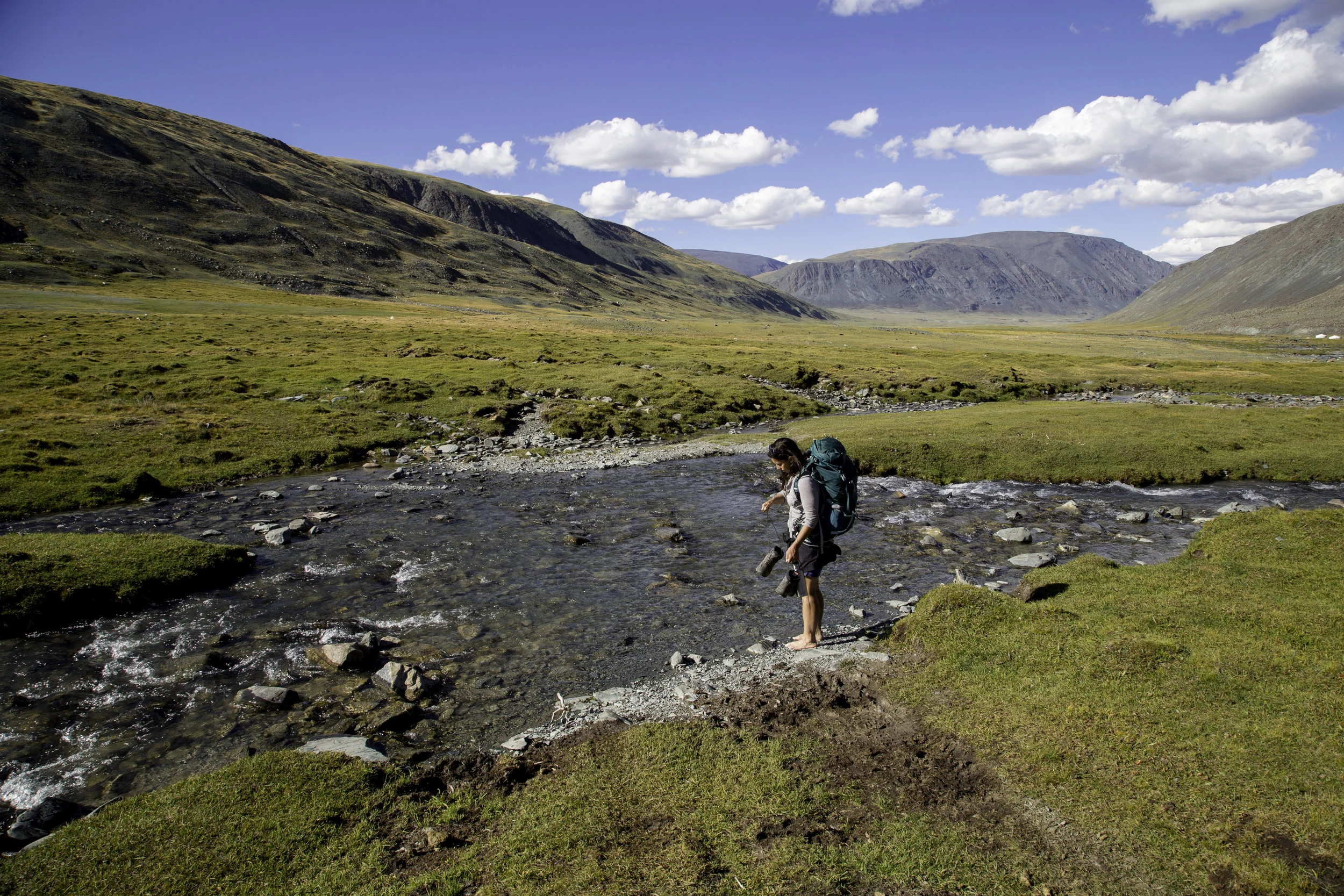
We slept in a nook on a hill between an rocky outcrop and the path, surrounded by marmot holes - we still did not get a good shot of them but it was another amazing night in the Mongolian wilderness.
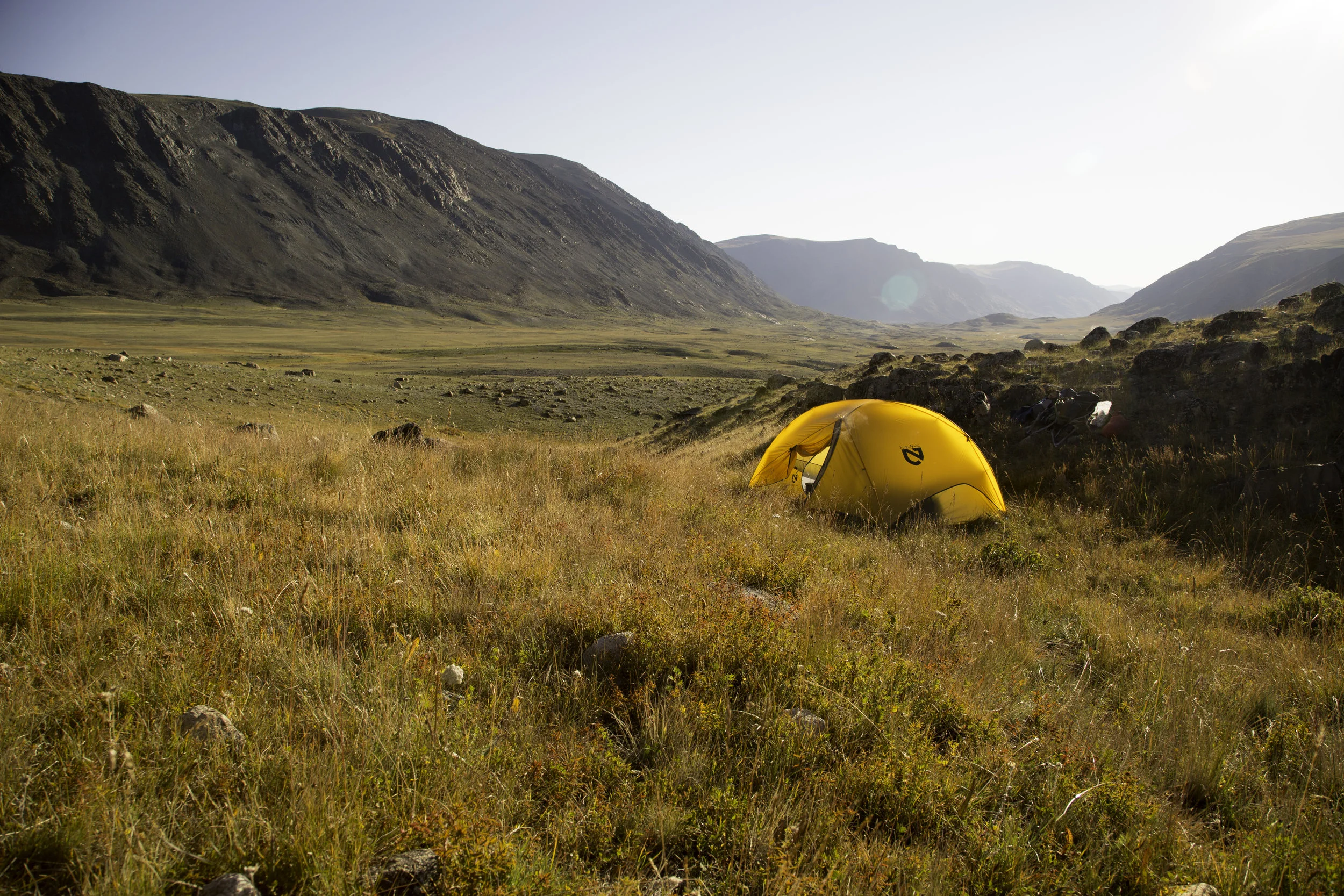
Big thank you to Morgan Gillham for the exceptional photographs!
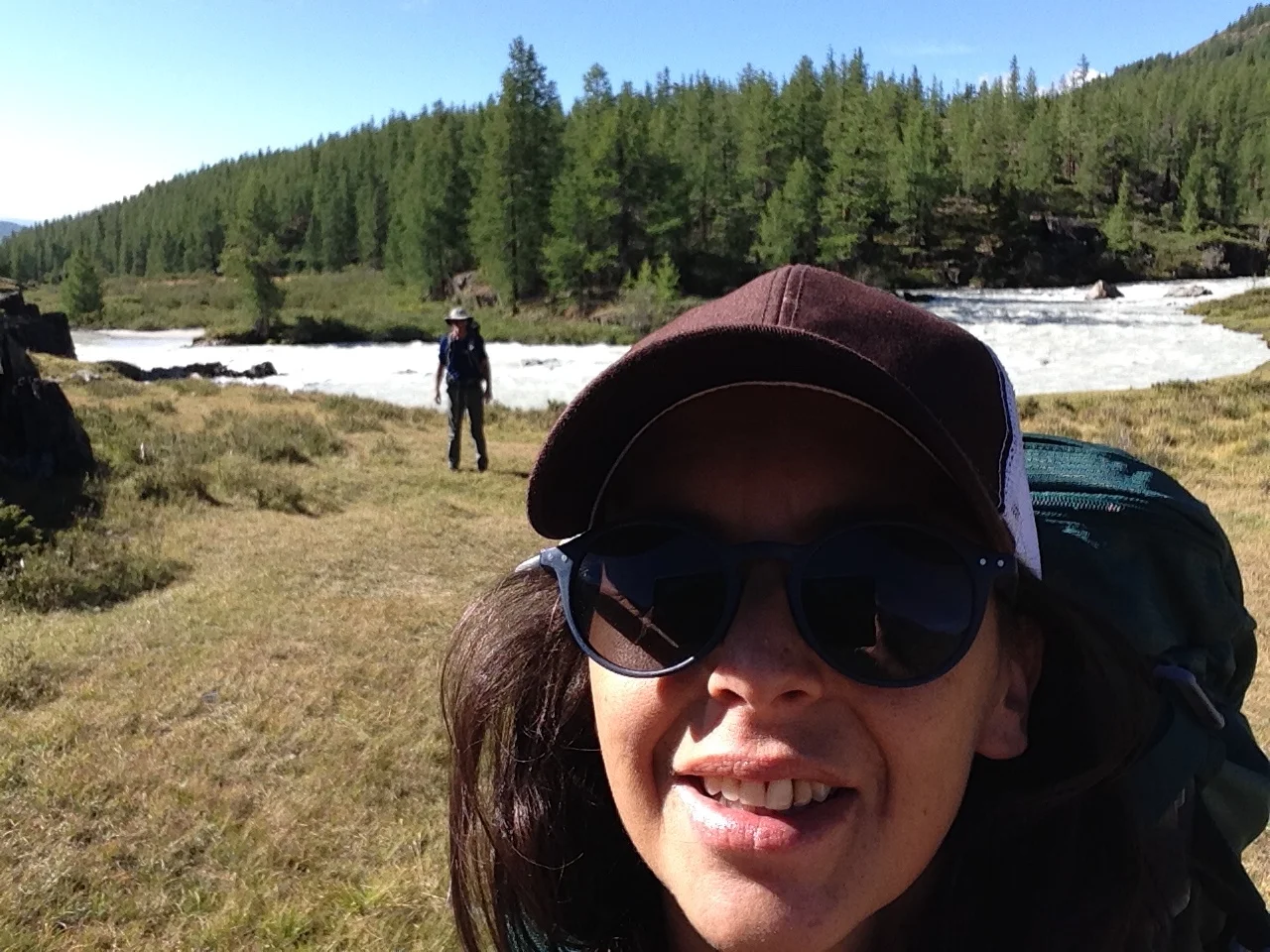
The river was loud and the ground was hard, but neither was loud enough or hard enough to stop us both from sleeping well. It was a magic spot with the river foaming white as it raced round the rocky bends, speeding past us roaring. I didn’t want to leave.
And yet, from the moment we set off, seen in this photograph above, walking was more than wonderful that whole day. I felt truly in a groove, comfortable with the weight of my pack, secure about food and water, I started to fully notice, enjoy and appreciate the flowers and insects, the different succulents sprouting out of rock crannies, the sounds of kites, hawks and eagles, the scurrying land squirrels...
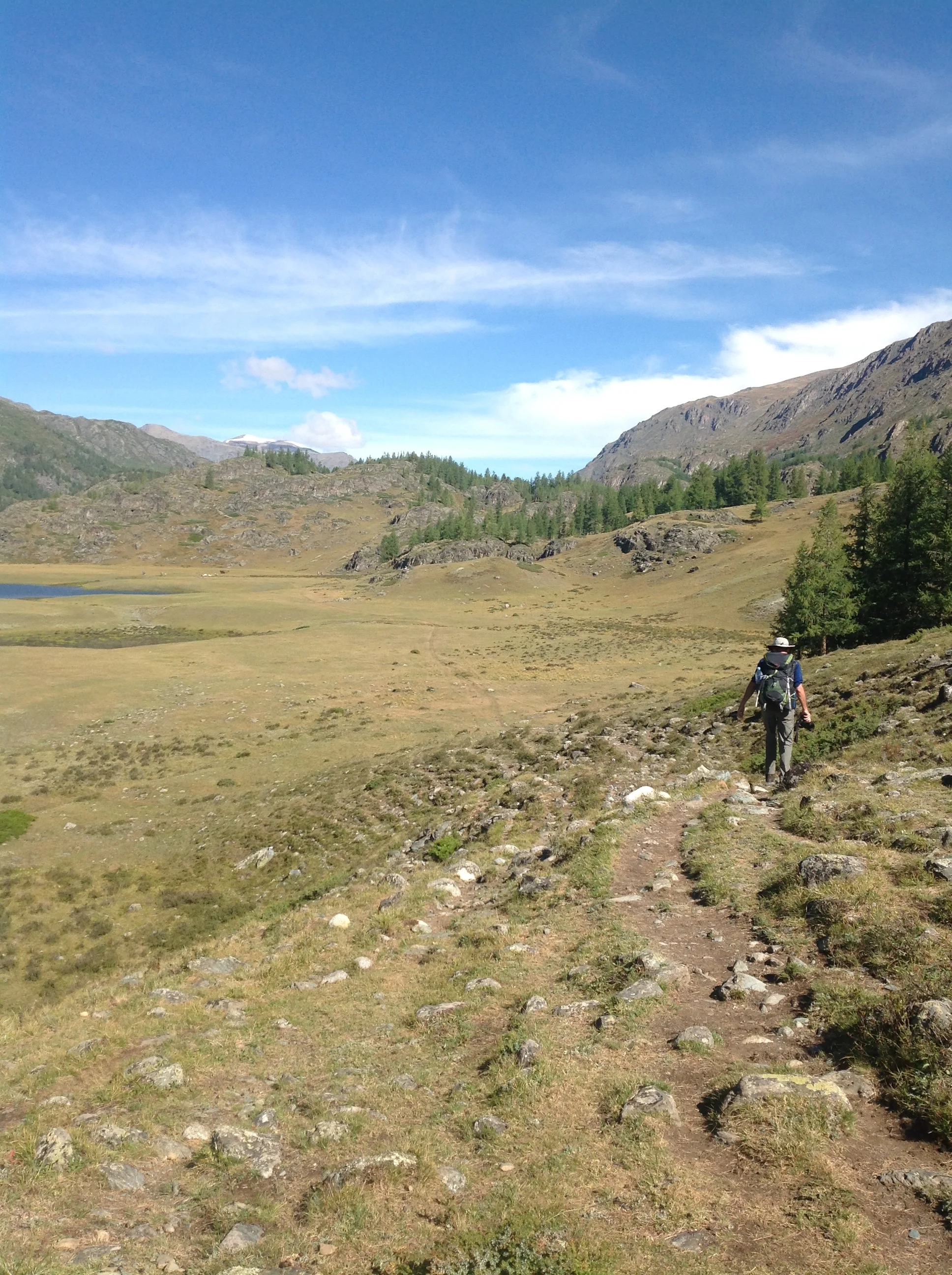
We continued to gradually climb, the terrain a combination of arid gravelly paths over rocky outcrops, clear dirt tracks through patches of forest and bog like wetlands on the lower sections of the valley… fast moving streams cascaded down the side of the hills around us.

We came across a tranquil lake where it would also have been magic to camp. Next time, I thought to myself.

Walking over the wetlands kept us alert, leaping over deceivingly shallow puddles to avoid drenching my boots.
Finally, we found the path we had to veer slightly east on and climbing got tougher and steeper, our breaths quickening as we ascended above the valley and up the mountain.
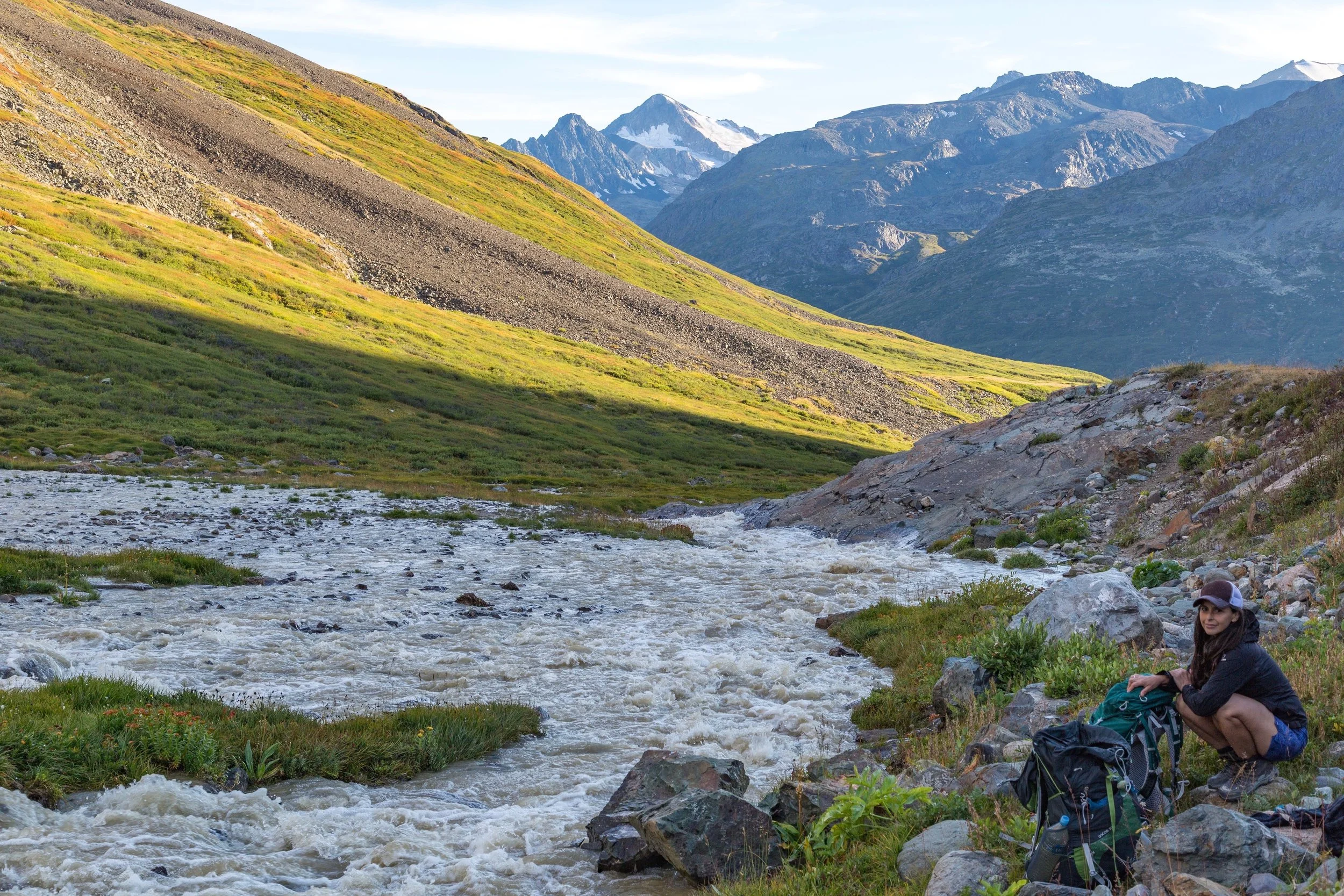
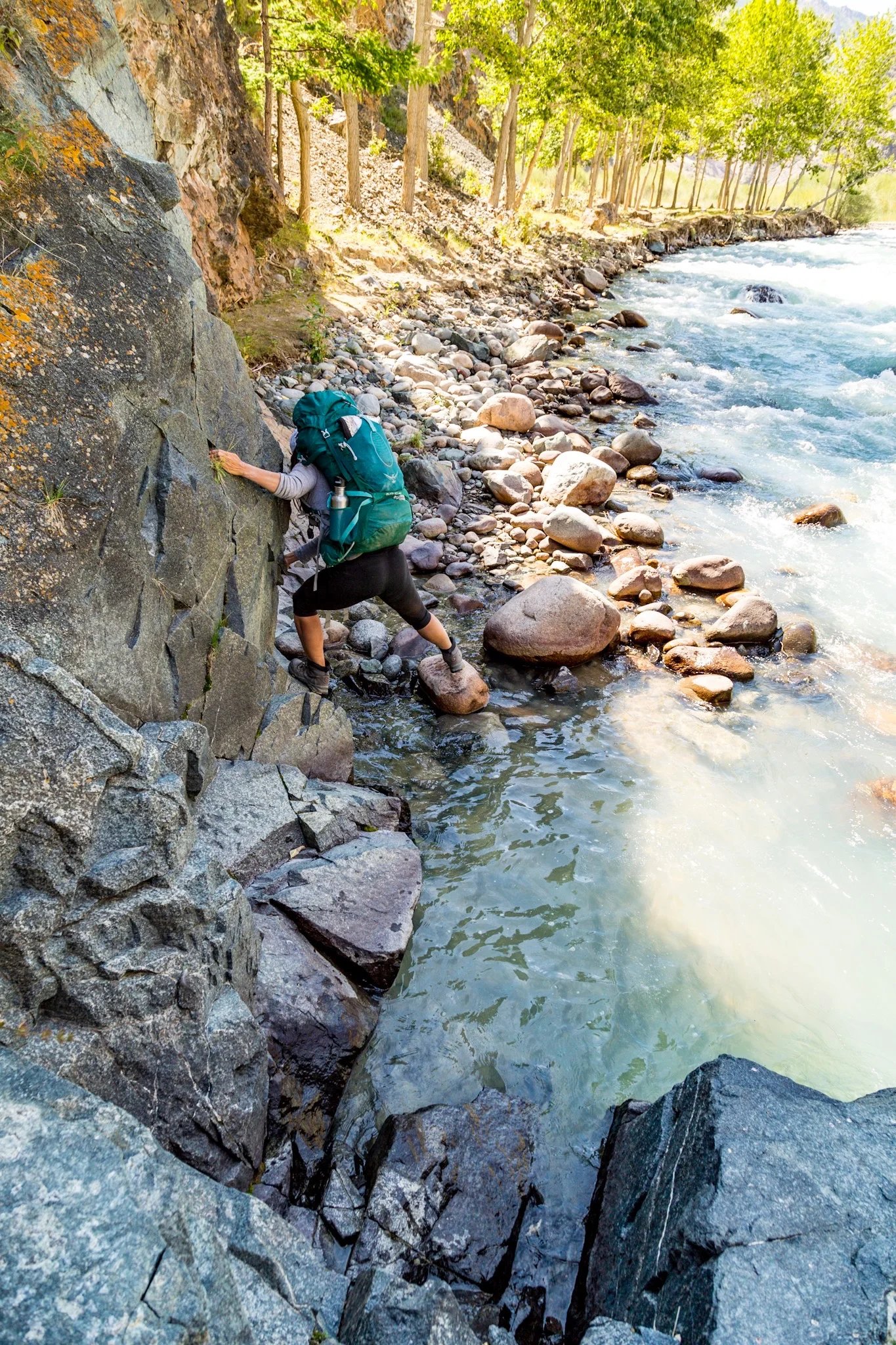
Eventually, sweaty, puffing and feeling the weight or our packs we once again found ourselves walking close to the edge of a not so shallow, wide and fast-moving river which we knew we were going to have to cross. We tried to find stepping stones so that we did not have to get our feet wet but in the end we waded across boots around our necks, backpacks unclipped – the glacier water bitingly, painfully cold.
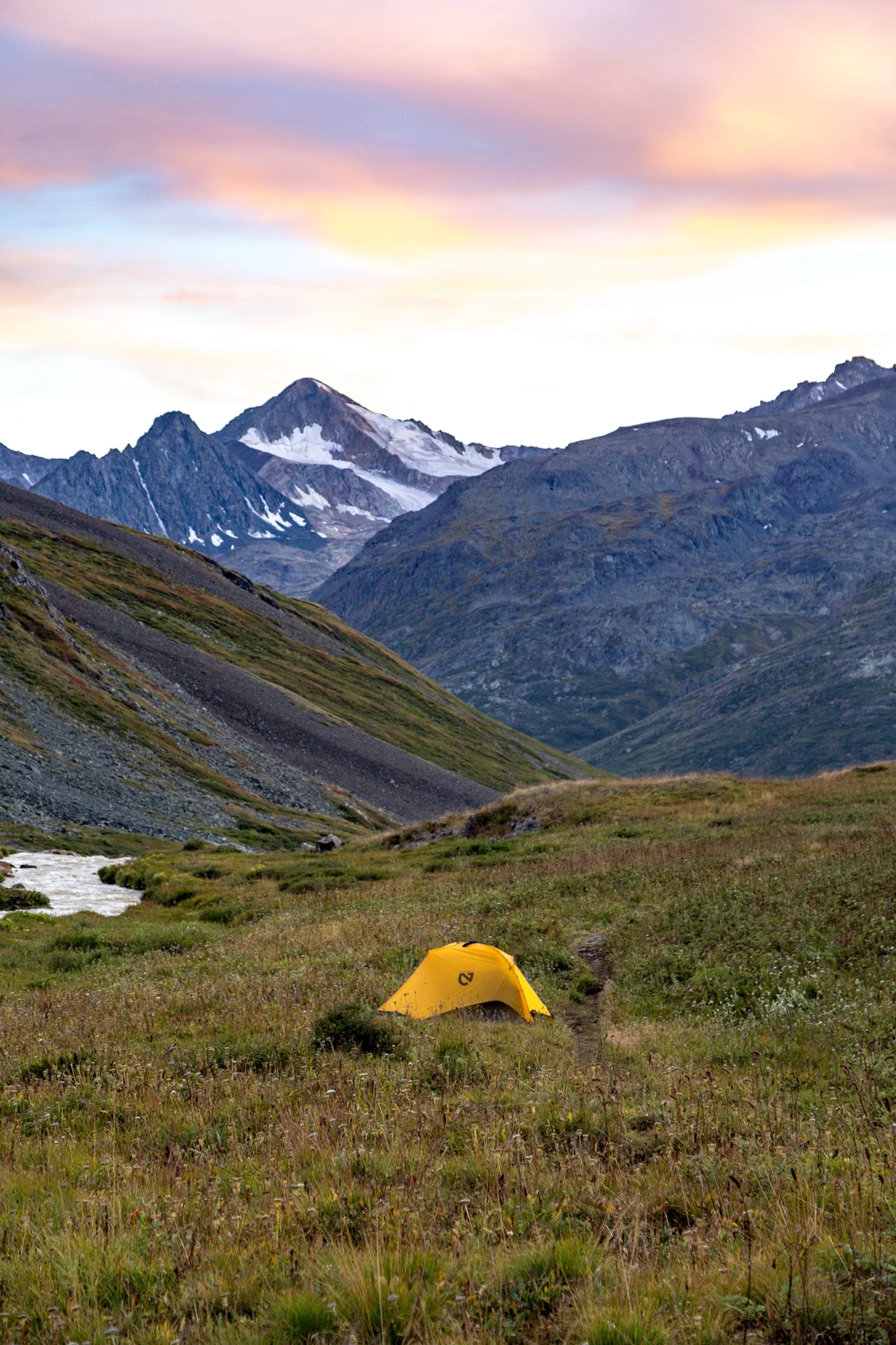
The sun was already going down when we got to a spot (above) and camped on the softest, warmest grass.
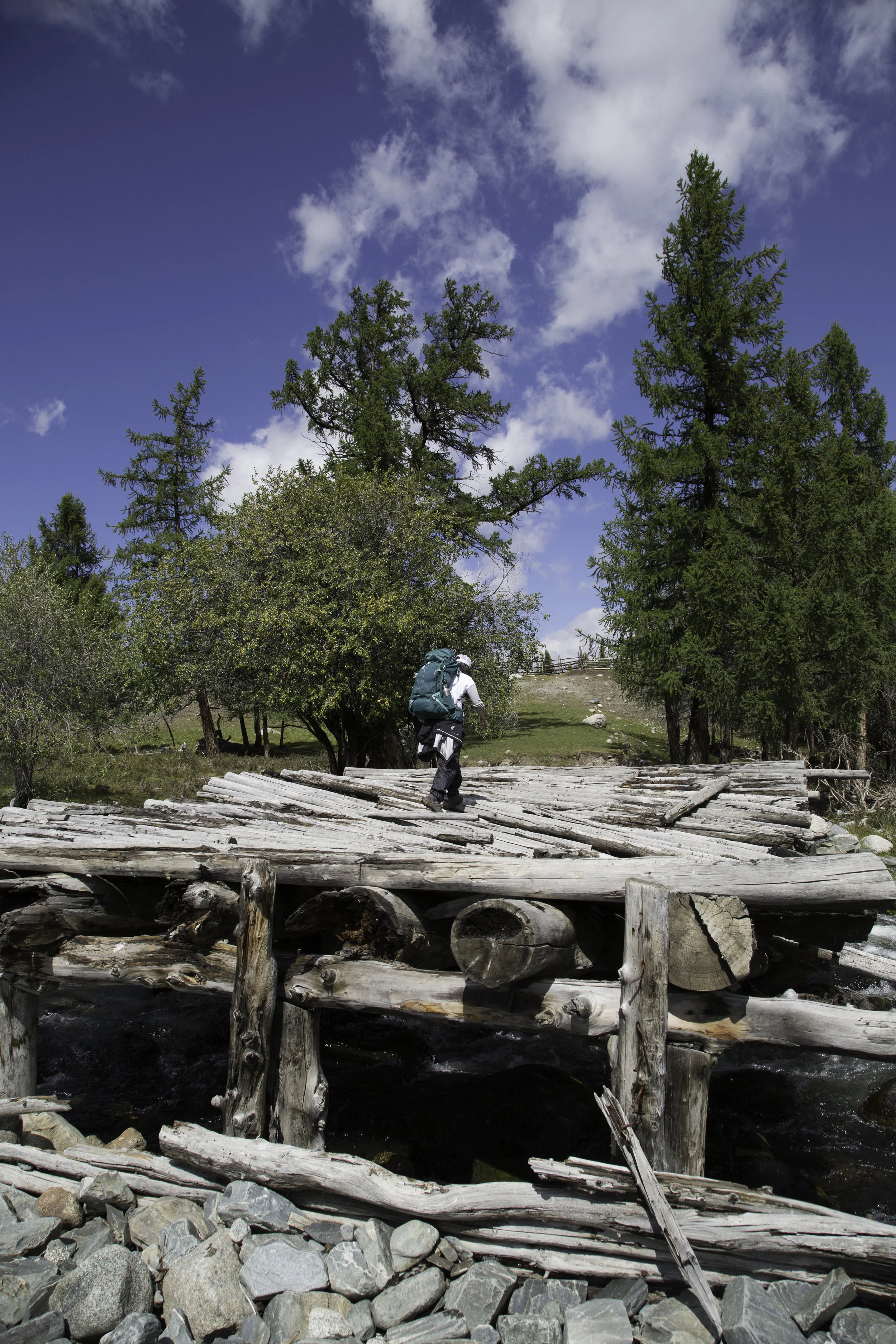
LAT 48.682500 LONG 88.209444
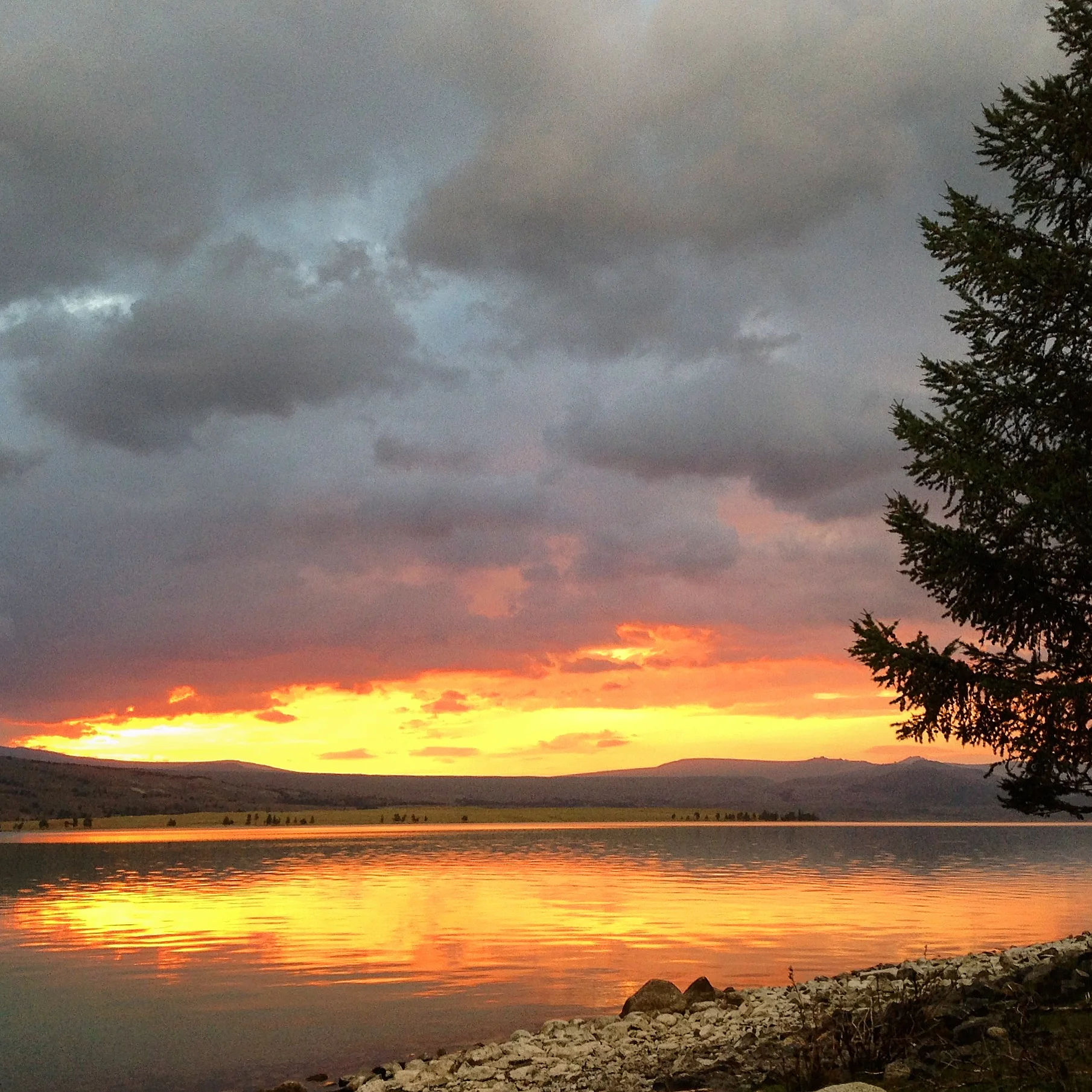
I woke before sunrise to a faint, early morning moon suspended pearl-like above the lake, followed by a sensational sunrise. Despite the early rise, a short but heavy downpour forced us to spend a couple more hours inside the tent, cocooned in our sleepingbags.
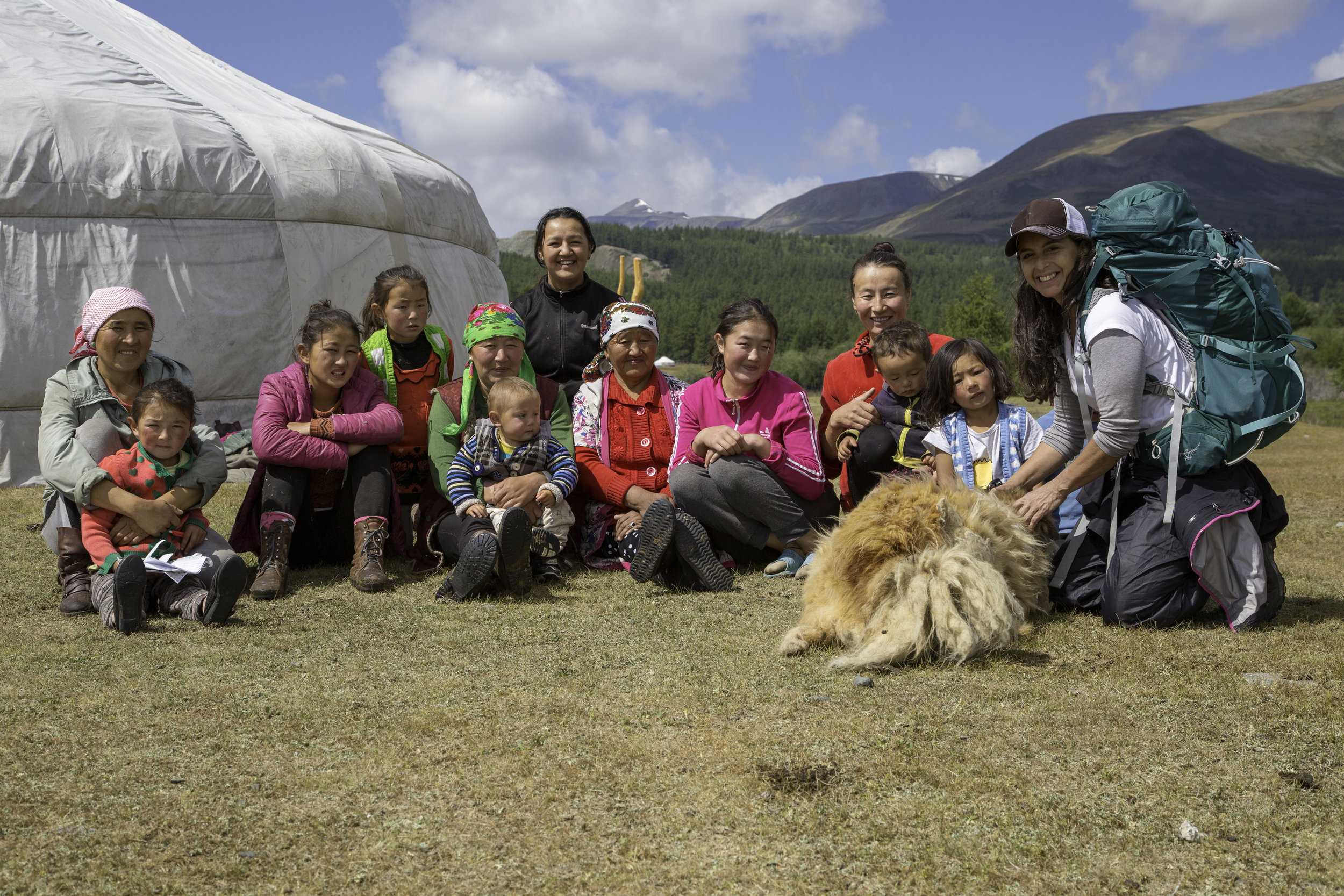
We met a group of Kazakh women and children as we walked away from the campground - they invited us in for tea but we were keen to get going as it was already mid-morning. We took some photos and exchanged names so that we could connect on Facebook and share them.
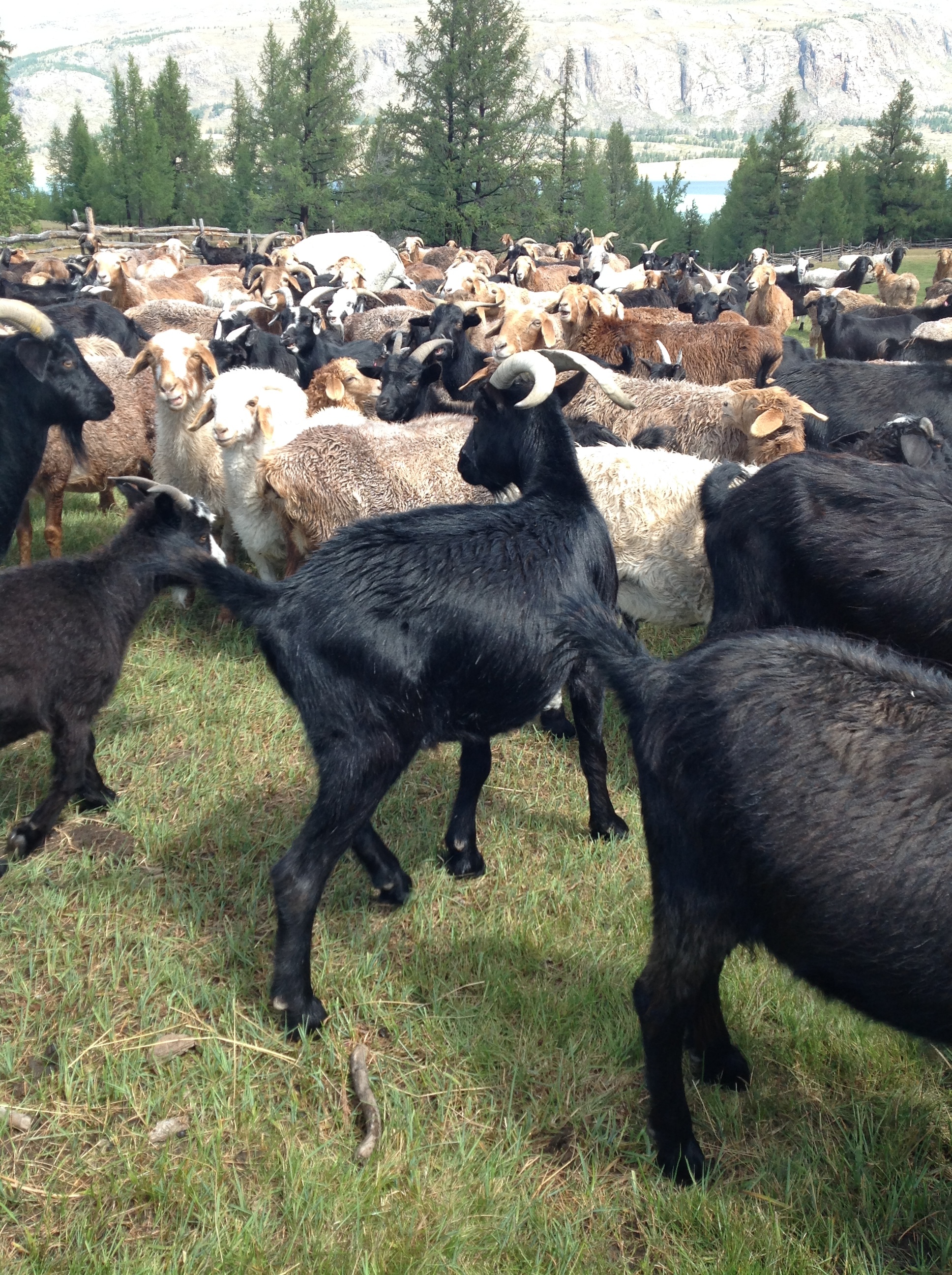
Nomadic family grazing their goats on the edges of Khoton Lake.
We started our first more rigorous stretch of walking today with some hills offering a welcomed challenge. It was just the right combination of warm sun and cool breeze for it too.
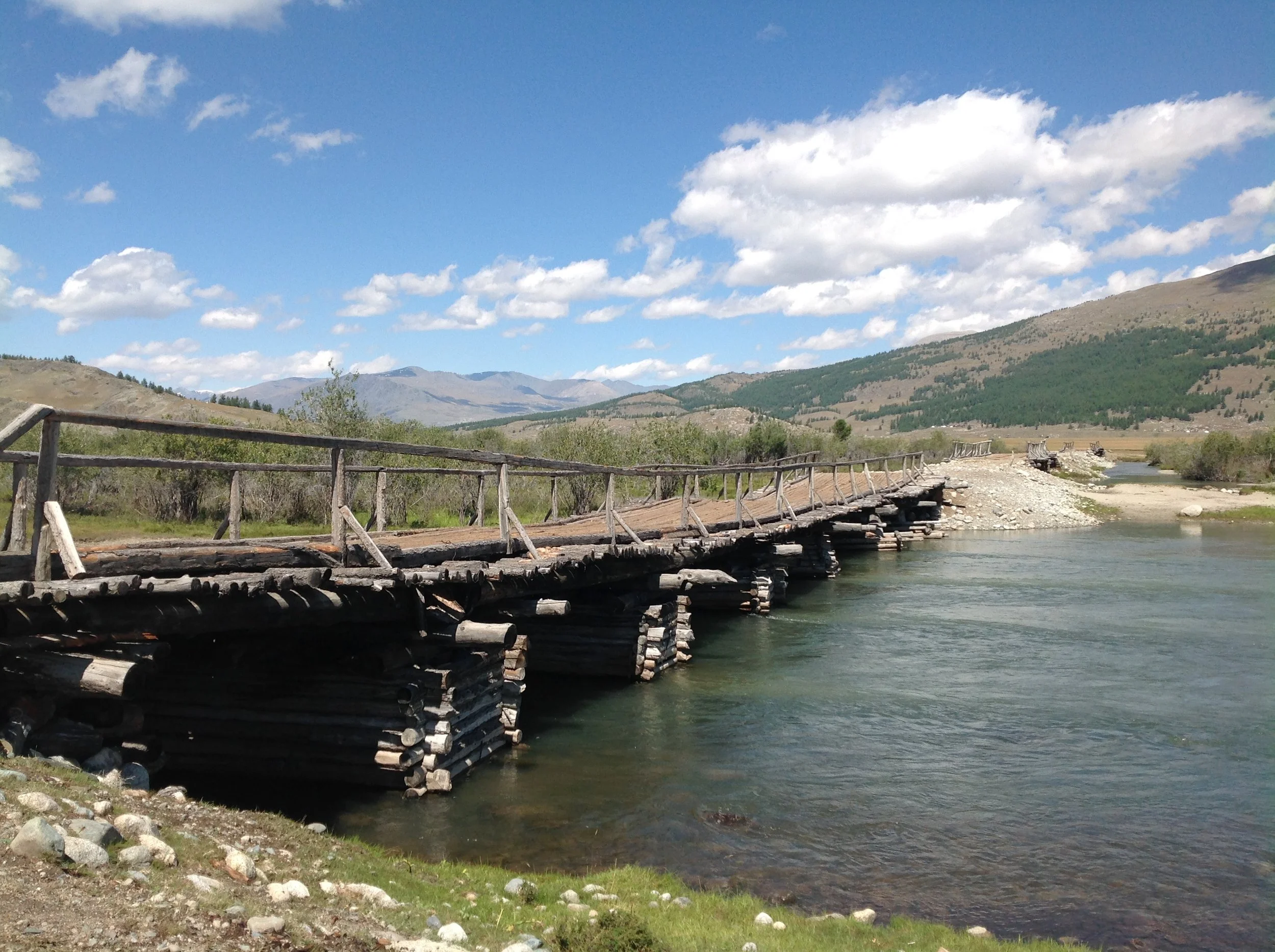
At the northern end of the lake, where the river flows into it from the mountain glaciers, we crossed another long wooden bridge that took us almost directly to the second ranger's station. While he casually looked at our permits and passports, the ranger pointed up river and asked ‘Tavan Bogd?’. We nodded as he signalled for us to stay close to the west side of the milky white river, carrying sediment from the top of the glacier.
We walked upstream with the river on our right through the boggy, darker, more muddy terrain on a clearly visible path. We met a group of hikers who were doing a one-day hike around the lake with a guide that went ahead of them on a horse - this section is a fairly well-trodden path clearly used by herders as well as hikers.

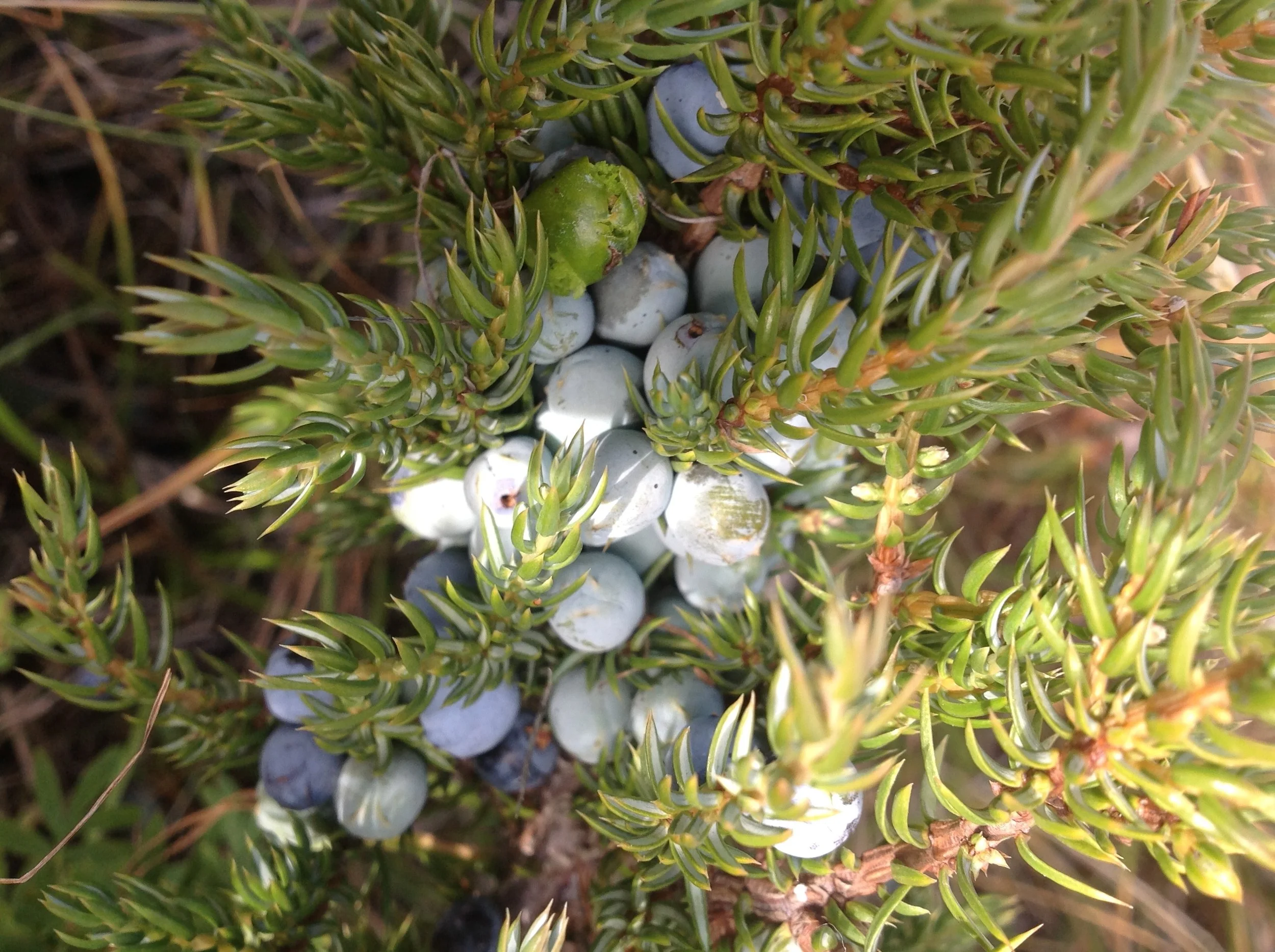
Further north we left the river on one side as we started to climb steadily up a large rocky outcrop fringed abundantly with juniper bushes and followed the clear path along the rocky ridge of a gorge.
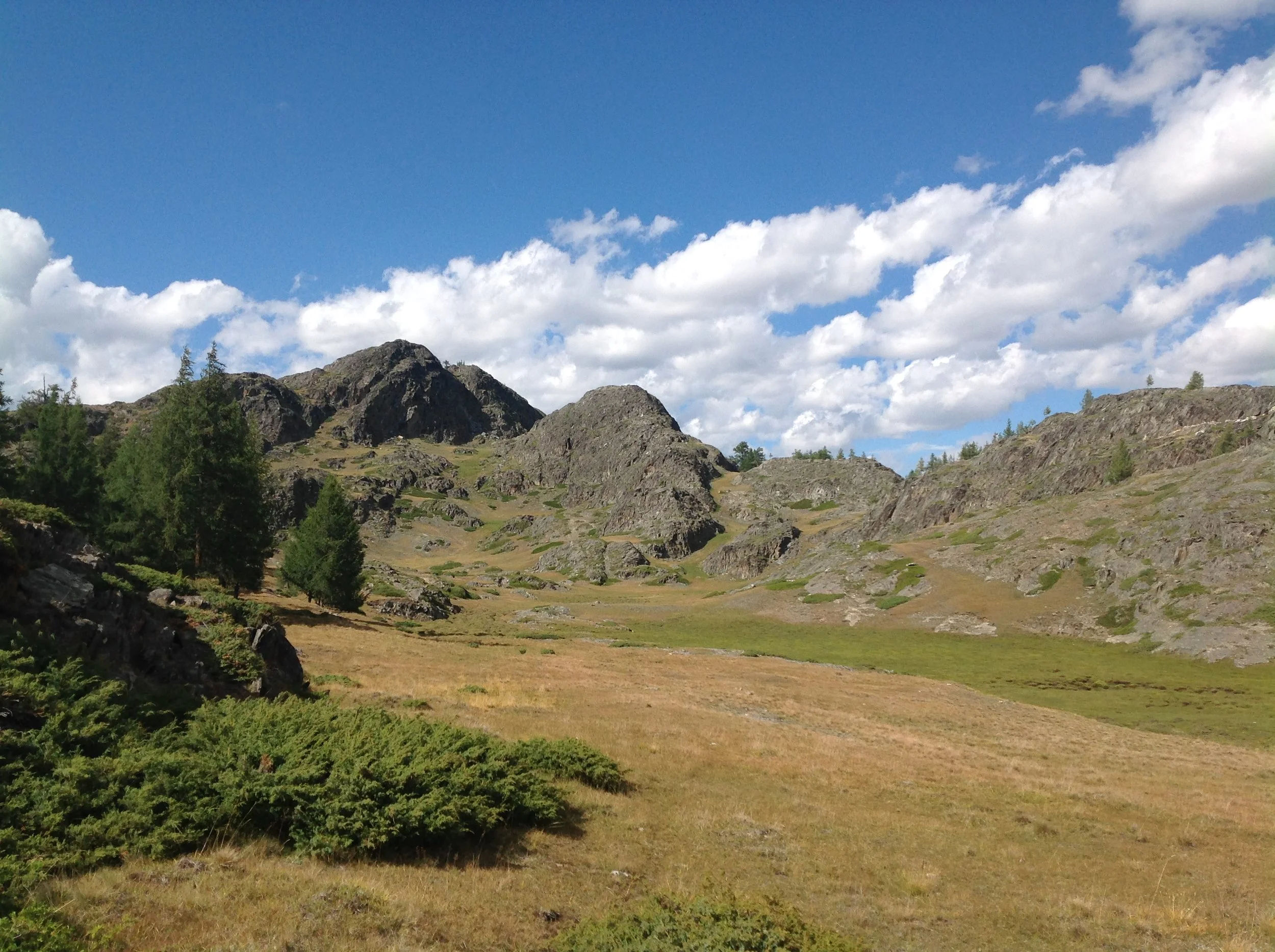
With the added elevation came impressive views of the lake on one side and snow-peaked mountain tops in the distance on the other. It did not matter where we looked, the views were magnificent.
We left the wide open space of the valley to go into a gorge where the valley deepens and starts to ascend into the mountains.
We camped beside the fast-moving river, loud and powerful, at a spot that had been used as a campsite before; firewood was left stacked on one side for us to find. We made sure we did the same and left a small stack of firewood with plenty of kindling for someone else to find.

Meals are so enjoyable on a hike. We had a hearty dinner of 2-minute noodles, miso soup, dried fruit, peanuts and coffee while enjoying the warmth of the fire and the sound of the river roaring past.
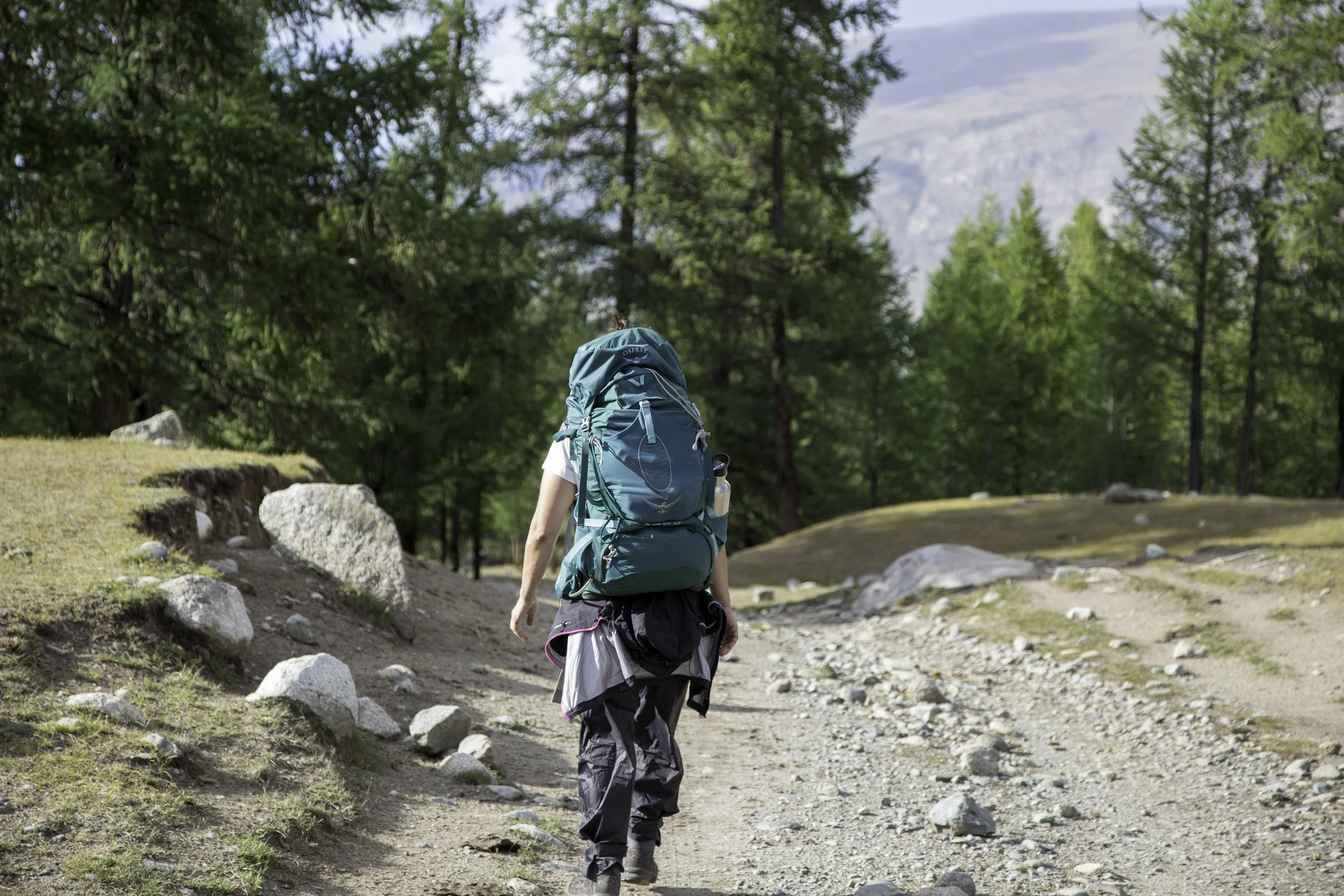
Coordinates: LAT 48.613889 LONG 88.341111
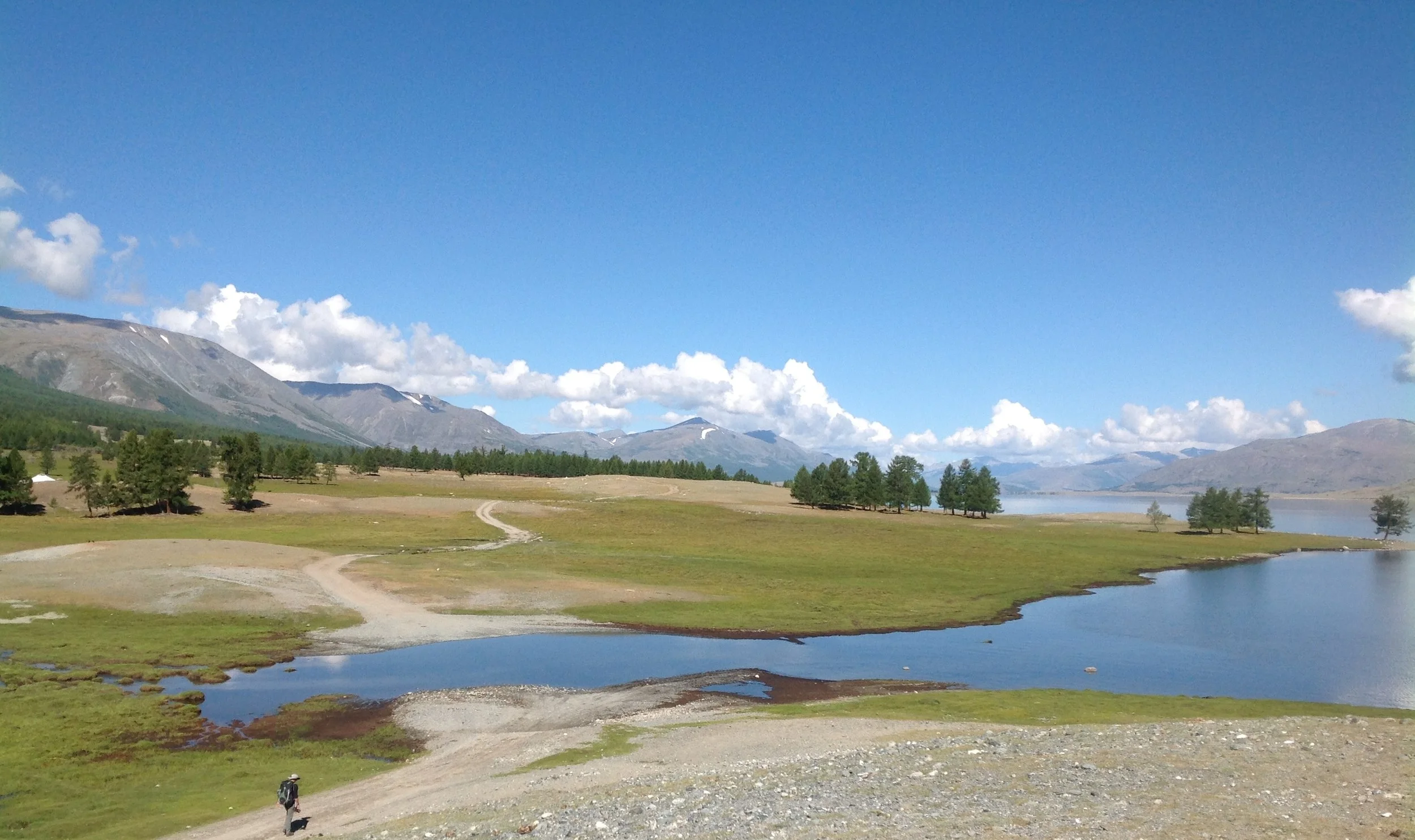
We set off early from the above coordinates and continued walking along the edge of the lake, as close to the water as we could, regularly coming across herds of yaks and sheep grazing. Occasionally, in the distance a couple of young children played in front of a 'ger' or yurt.
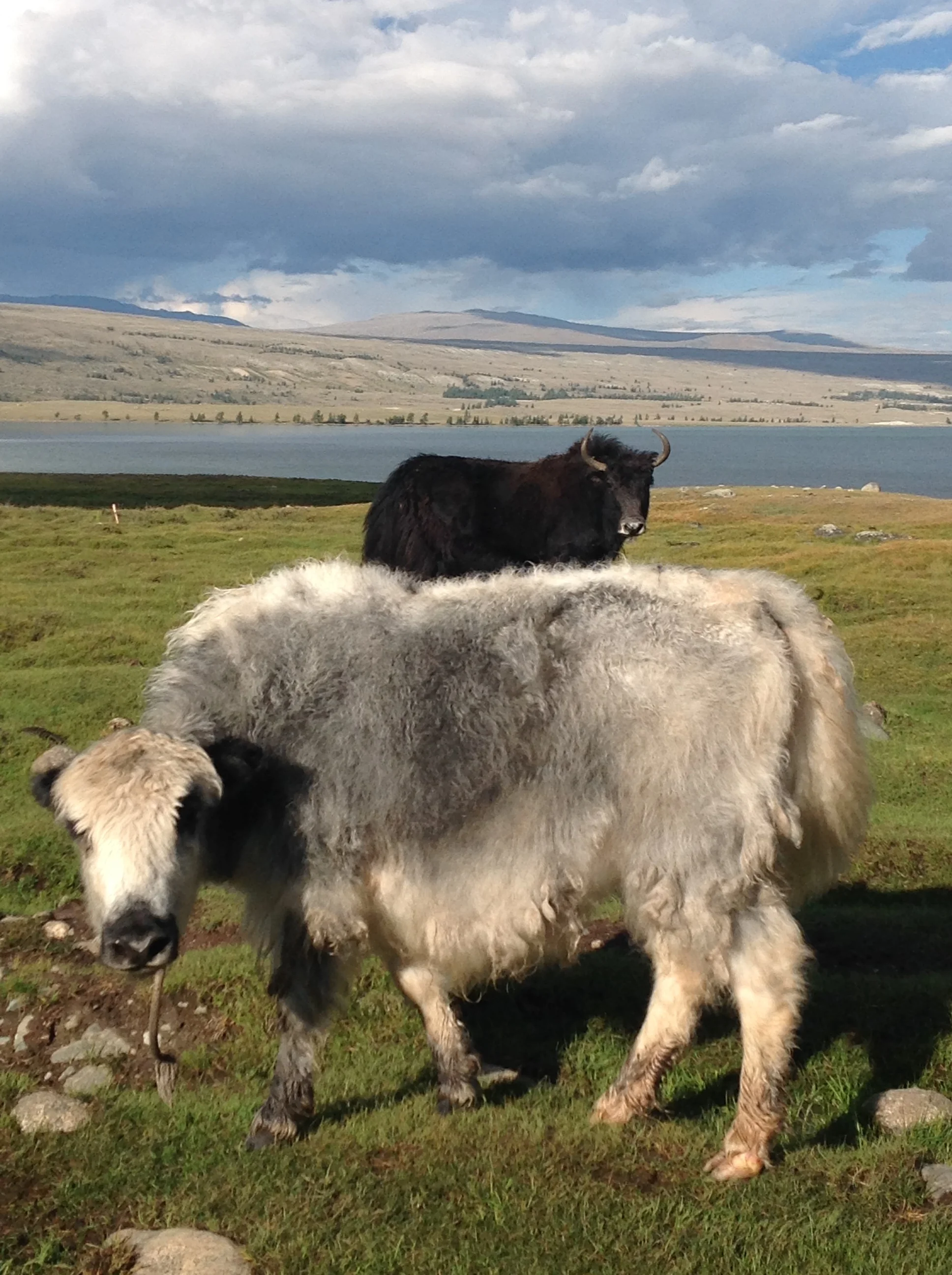
Walking on this side of the lake meant walking through patches of fairly dense larch forest.

We also walked through quite boggy terrain surrounding meandering creeks and brooks that empty into the lake. We had to cross many of these waterways by taking off our shoes and wading through calf high water.
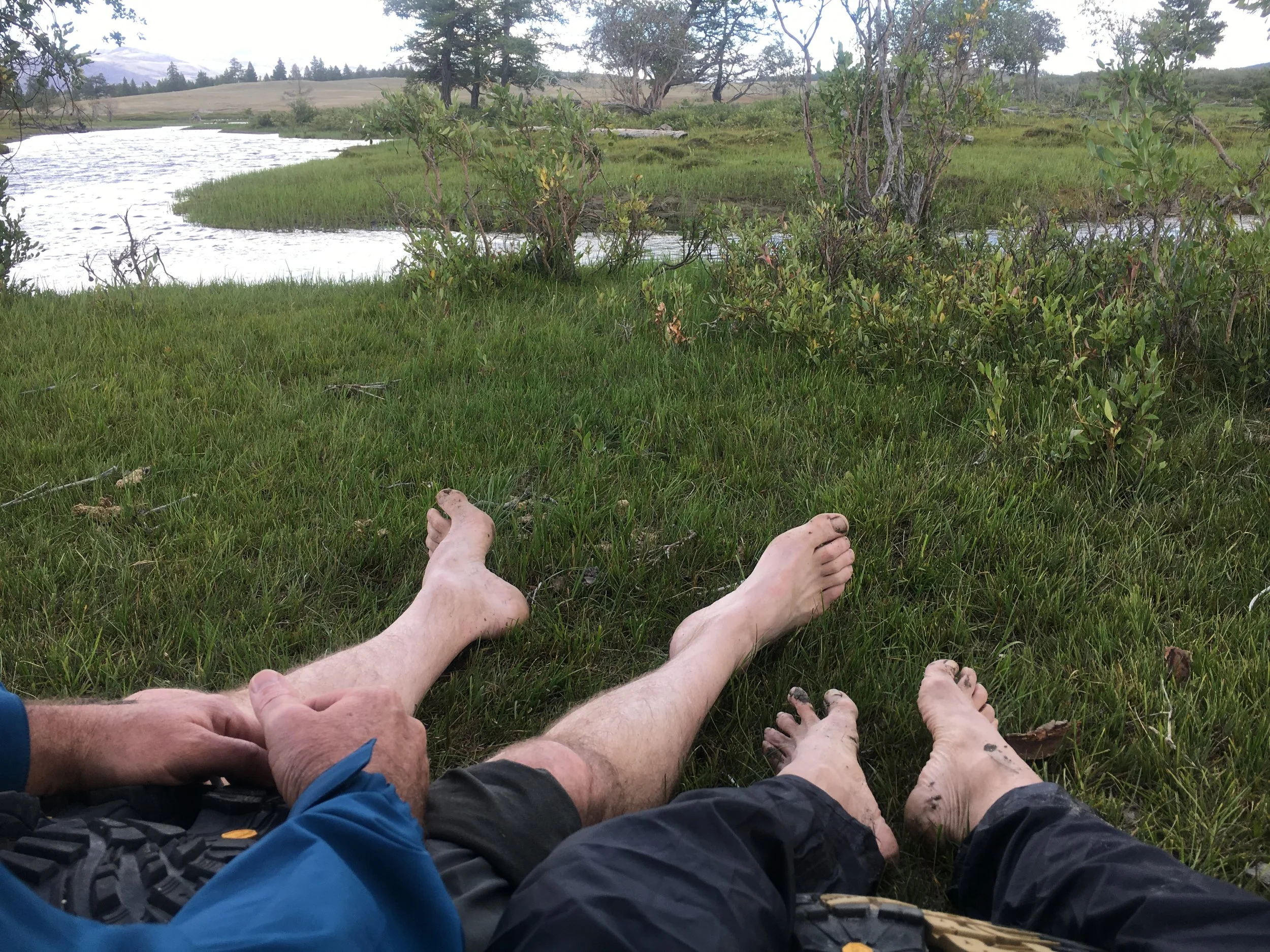
Today it took us a while to figure out a way across the delta-like network of streams emptying into one side of the lake. We took off our shoes and waded to sandy islands that deceivingly seemed to offer a shallower place for crossing.
Soft and spongy, the grass underfoot squished between muddy toes half expecting to be jabbed with a stick or rock. While on one of these sandy islands vegetated by bushes and water grasses, we noticed big weather building up in the north on this side of the valley and in the distance heavy water fell on happy pines on our side of the mountain.
We hurried to get our wet weather gear out and scrambled to take cover in between the branches of a small, bushy tree. In our plastic pants and rain jackets, bare feet (cause we had been wading) we sat there for 15 minutes while the rain came down of us in buckets. Grateful for wet weather gear we continued until we found a way across this wetland section of the lake.
We camped only 6 or 7 metres form the edge of the Lake, the water lapped the mossy pebbles all night while a full moon and a warm fire made it a very peaceful. My wet shoes dried completely next to the fire.
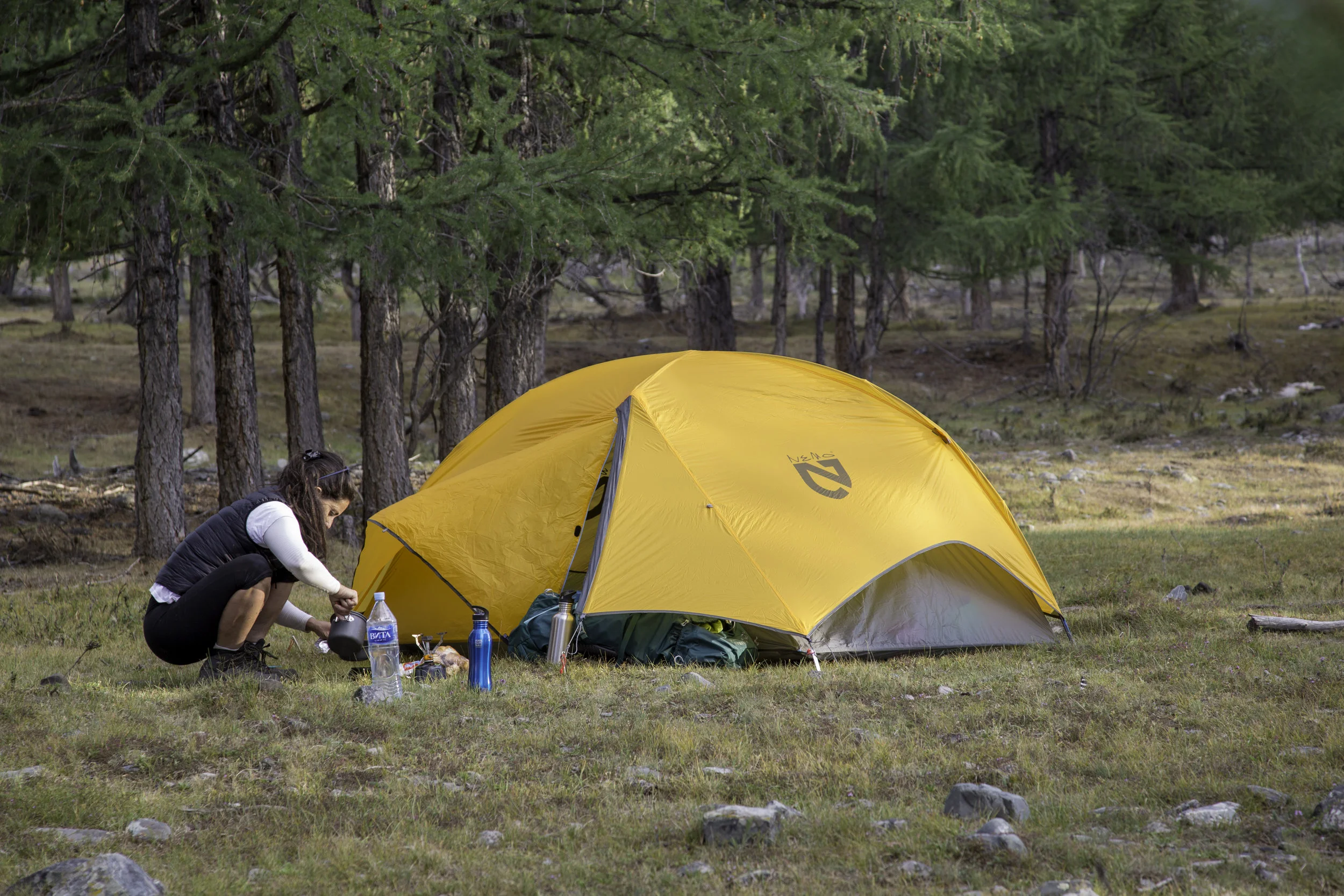
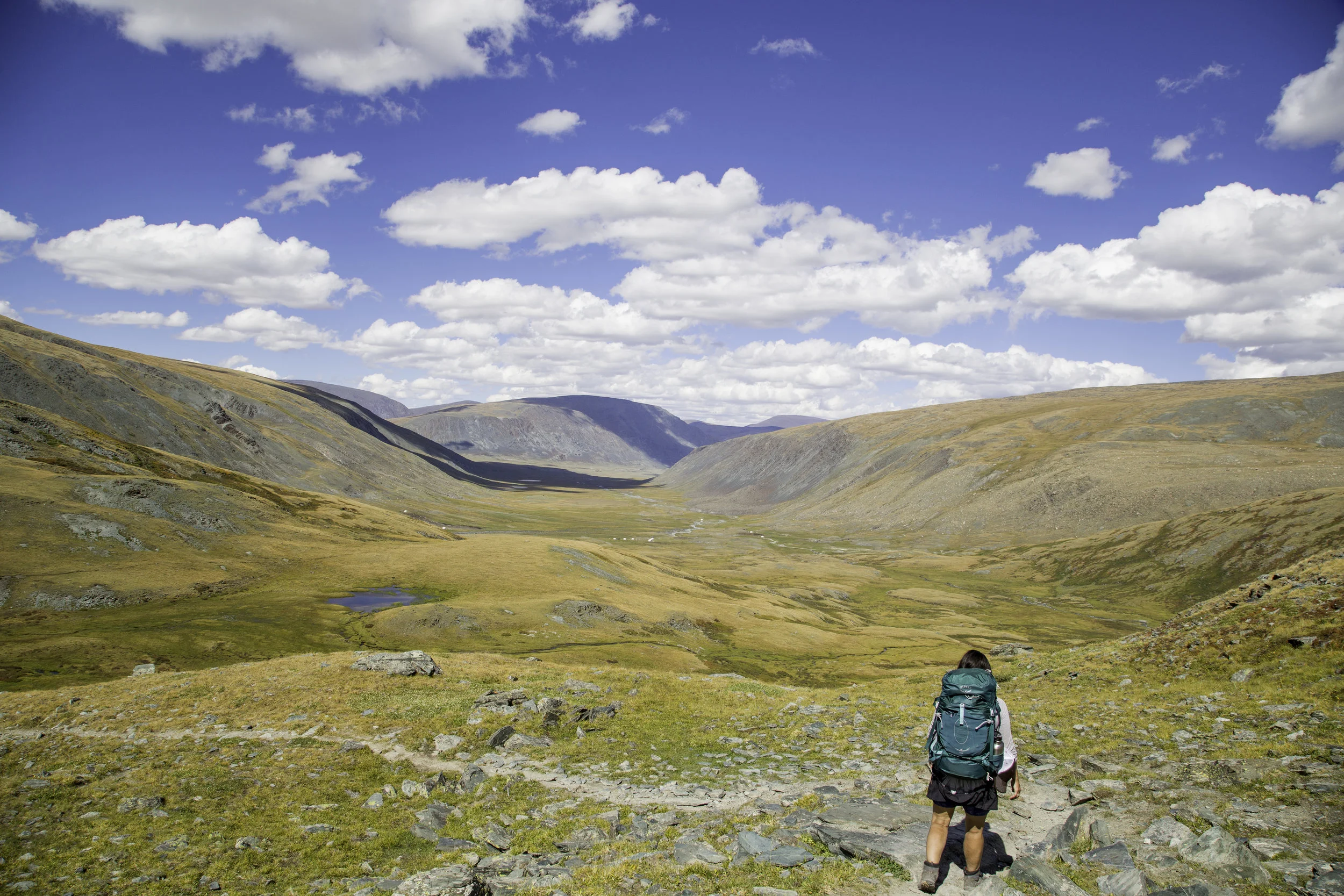
Tavan Bogd National Park, a walkers paradise in Mongolia's northwest. Photo Morgan Gillham.
This is a photo essay follows an 8-day hike through the Tavan Bogd National Park, approximately 1,700 km from Ulaan Baatar (UB), Mongolia’s capital, and home to the Mongolian section of the Altai Mountains. In summer, it is home to many Tuvan and Kazakh nomadic herders who bring their animals to graze in its pastures. Tavan Bogd is also an idyllic place to spend day after day walking immersed in unspoilt and remote wilderness.
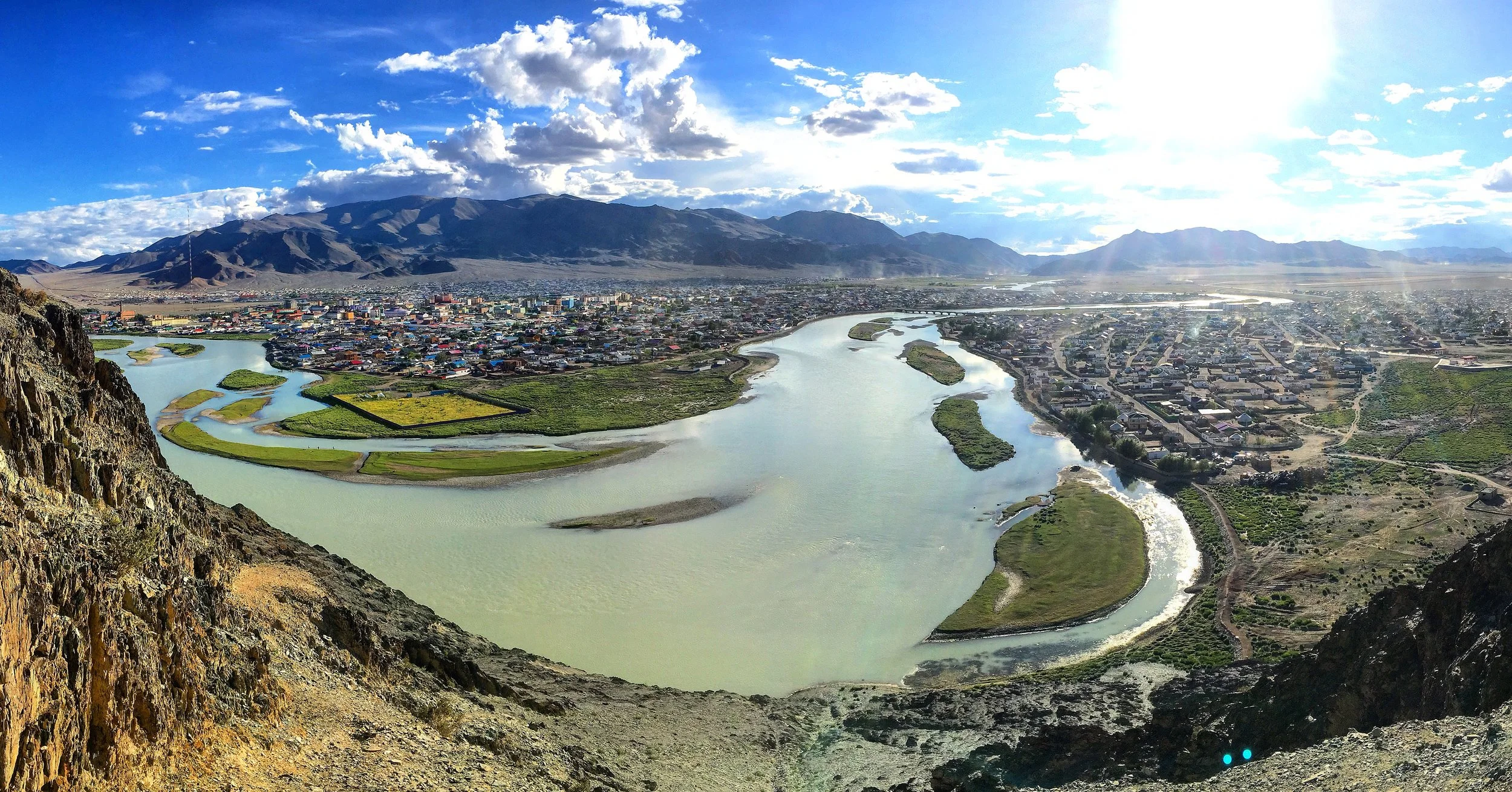
Ulgii - the River Khovd and mountains all round this Kazakh town and gateway to the Tavan Bogd National Park.
We left Ulgii from the northwest end of the town, past the airport where the bitumen road ends and almost seamlessly veers slightly to the left and onto a dirt track. Most of Mongolia road travel takes place along this colossal network of dirt roads and paths on which you rarely see a post or sign for directions.
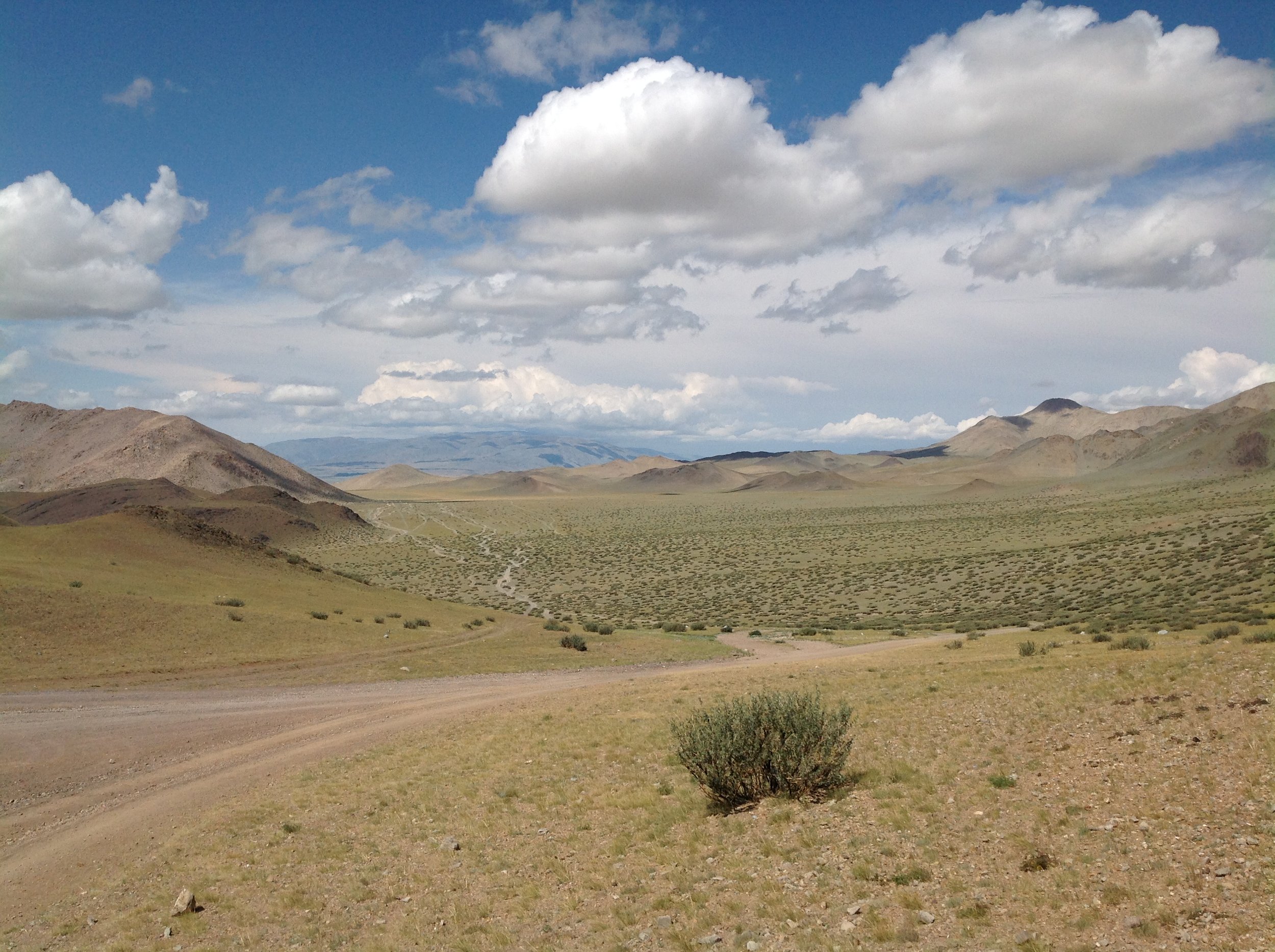
Leaving Ulgii... no signs or posts in sight!
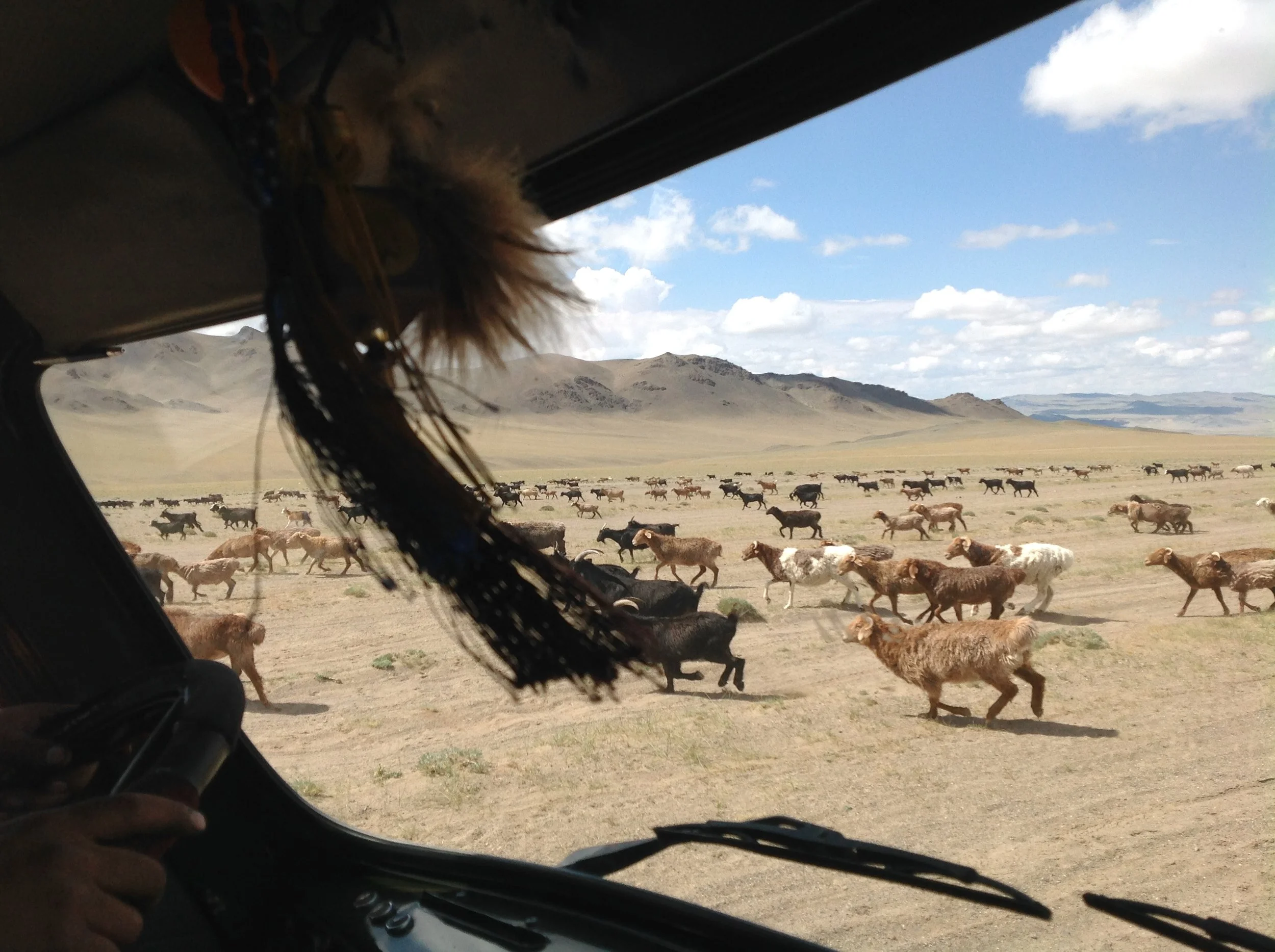
It is an exciting, bumpy ride inside the Russian furgon (like a 4WD combi), we coasted down the side of hills like we were riding rough waves on open seas; bouncing and sliding on the felt seat covers, slowing down often to let the herds of sheep or goats scatter around us, and let us through.
On the way to the park we drove through Tsengel district and stopped at our driver’s sister’s place for something to eat. For visitors, food is probably one of the most challenging things about Mongolia, especially those of us who are vegetarian or vegan. On this occasion, in characteristic Mongolian/Kazakh hospitality we were offered a freshly–made stew of goat liver and potatoes. My meat-eating companion braved the pungent dish while I was happy with the homemade bread and black tea.
The drive was exciting: long stretches of undulating grassy green hills with yaks, horses, goats and sheep grazing in herds. In the horizon snow-peaked mountains, beside us rushing rivers and creeks whose crossings require skilled 4WD action over uneven, pebbled banks; above us, endless skies with large, greying clouds.
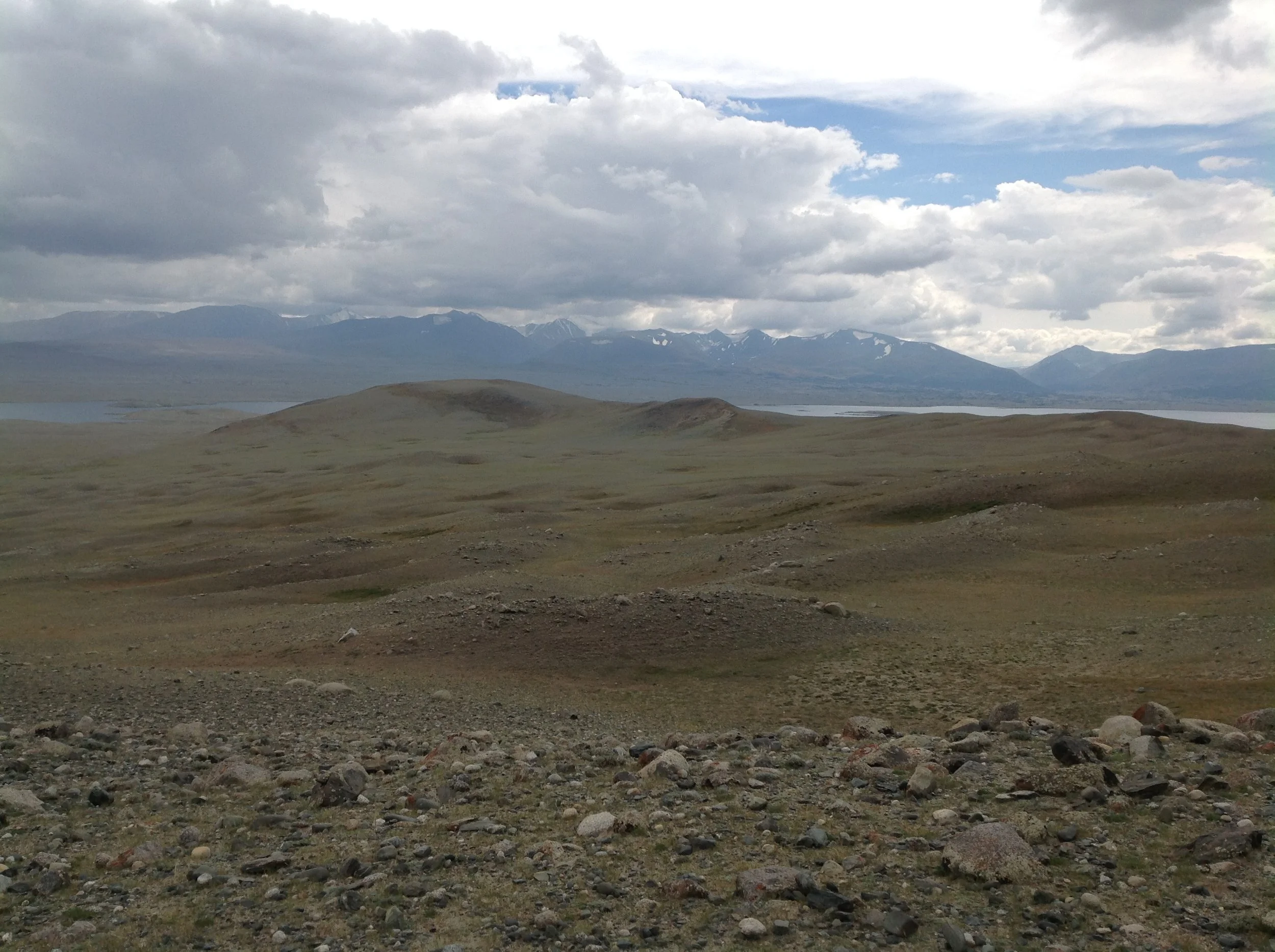
Here Khurgon Lake just south of Khoton Lake can be seen in the distance...almost there. Five and a half hours after leaving Ulgii we arrived at this bridge at the southern most end of Khoton Lake, the start of our hike.
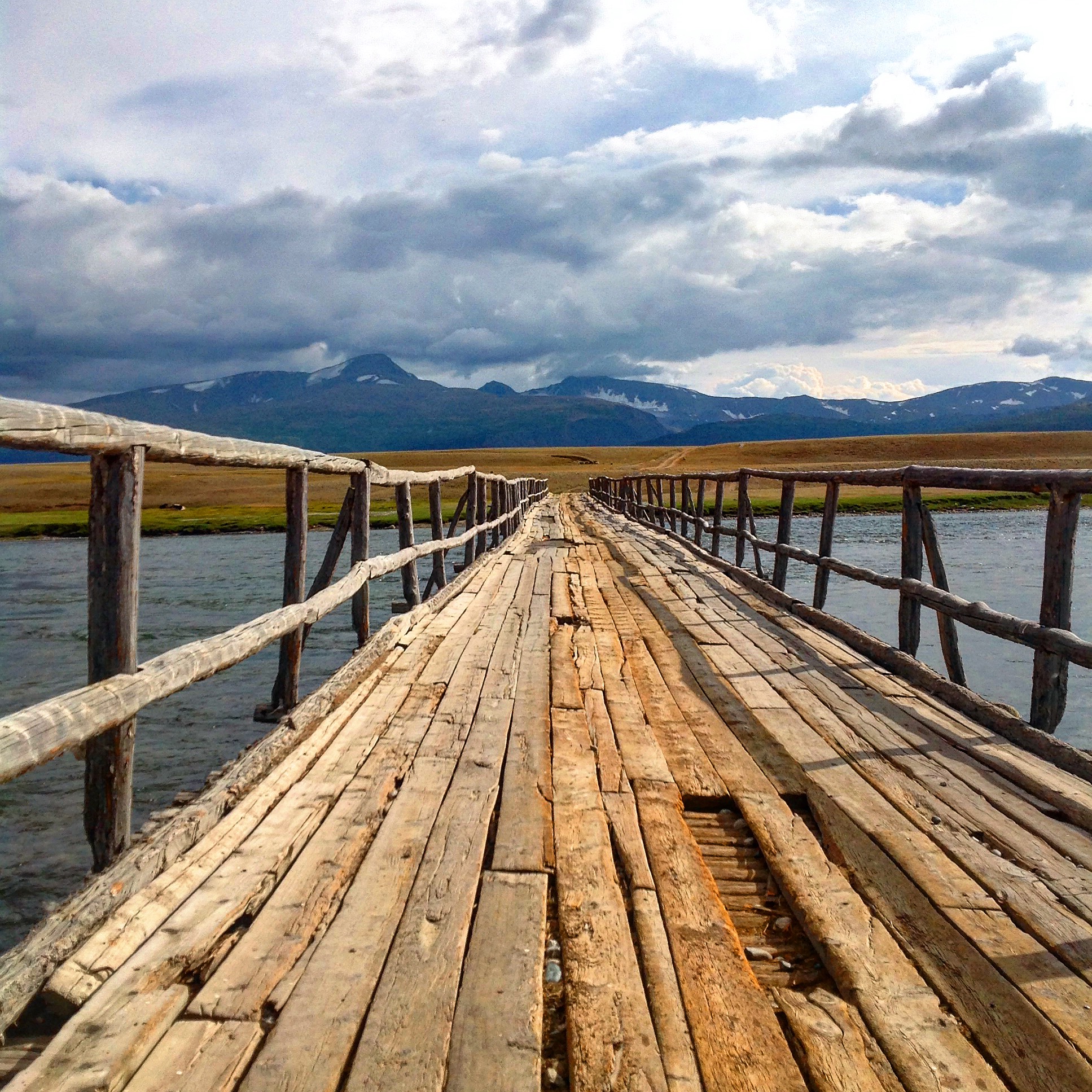
Khoton Lake - the start of our hike is at the southern end of the lake.
Our walk starts here with a bridge crossing over Khoton Lake (above) at about 2,000 metres above sea level. We said good bye to our driver and double checked our pick up from the northern entry into the park 8 days later.
After sitting in the van for half the day we walked energetically, the lake on our right, China not far on our left and all around scattered larch trees and remaining trunks, hacked, evidence of significant clearing, probably for firewood.

Not long after crossing we said hello to a group of Russian mountain bikers who had ridden around the 50 square kilometres of Khoton Lake; the lake is quite popular with Russian tourists who come to camp and fish in its plentiful waters.
After about 8 km we found a patch of grass free of twigs and rocks from where we could set up camp. As the sun set on this first day of our 8-day hike through the Tavan Bogd National Park this pack of horses walked past us in the distance...a great last view of the day on this already amazing journey.
Check out or Instagram page for more great photos!
"Traveller there is no path, the path is made by walking"
Antonio Machado
I try to walk my talk. I strive to live a creative & self-expressive life, a life that gives me daily opportunities to be curious, to explore & discover, not only the natural environment and all its inspiring beauty & spectacle, but also the inner wilderness of my own creative potential.
I know that most of you reading this blog strive to do this too, and I know that most of you, like me, struggle.
It’s not easy, we are constantly pulled towards safety & comfort; towards the familiar & the certain; towards all the things we do really, really well. It’s hard to resist, isn’t it? Who doesn't want to choose guaranteed success over potential ruin? Safety & comfort over ridicule & flat-on-your-face-ness peril?
Despite this, creativity & self-expression have a central place in my life, just like sunshine & water – to me life without them is mediocre & bland. For this reason, I have become very conscious & vigilant so that I am prepared for everything that emerges during this often mysterious process.
1. Be prepared to not know the way – the creative process is generative, that means that each step you take generates a whole set of potential unknowns, offering a selection of new paths. The thing is, you can’t know what these are going to be until you have taken a step.
Generative means that you are walking and you are making the path at the same time. You have to let it emerge, observe it, and step into it with complete trust that it is going to take you to the place you want to go.
I’m not saying go out into the wilderness not knowing where you want to go, I am saying be prepared to walk along overgrown paths, rocky terrain, cliff edges or even machete yourself a new path because, to stay with the metaphor, nobody has explored this part of your wilderness before, so there is no one right way to get where you are going.
2. Be prepared to stay a while because the creative process requires us to dwell in uncertainty. Take plenty of water, a compass, your soft, self-inflating sleeping mat, whatever you need and camp out in the unknown. Creativity is in our DNA, the challenge is in letting go, waiting, allowing, and trusting.
3. Be prepared to do it badly, because more than anything the creative process requires that you work no matter what. Carve out time each day to write, sing, play the guitar, plan your business – whatever you are up to, make sure you do it because only by doing will you improve, grow & thrive as a creative force.
4. Be prepared to move away from people who do not support you because the creative process will make you feel both invincible & vulnerable. We need to be around people who are ok with us at our fiercest & most confident as well as at our weakest and most frightened.
As Julia Cameron puts it we need people around us who are OK for us to be ‘as big as we are and as small as we are, as competent and powerful as we are, and as terrified and as tiny as we sometimes feel…’.
So, surround yourself with people that inspire you to keep making your path as you walk it, who encourage you to stay put when you feel like packing up, who support you not only when you feel brave but also when you feel insecure; and, most importantly, surround yourself with people who strengthen your resolve to keep working & thriving every day.
May 2018 be a year for all of us to keep walking our unique, fulfilling, joyful & abundant creative paths...and one or two dirt paths too.
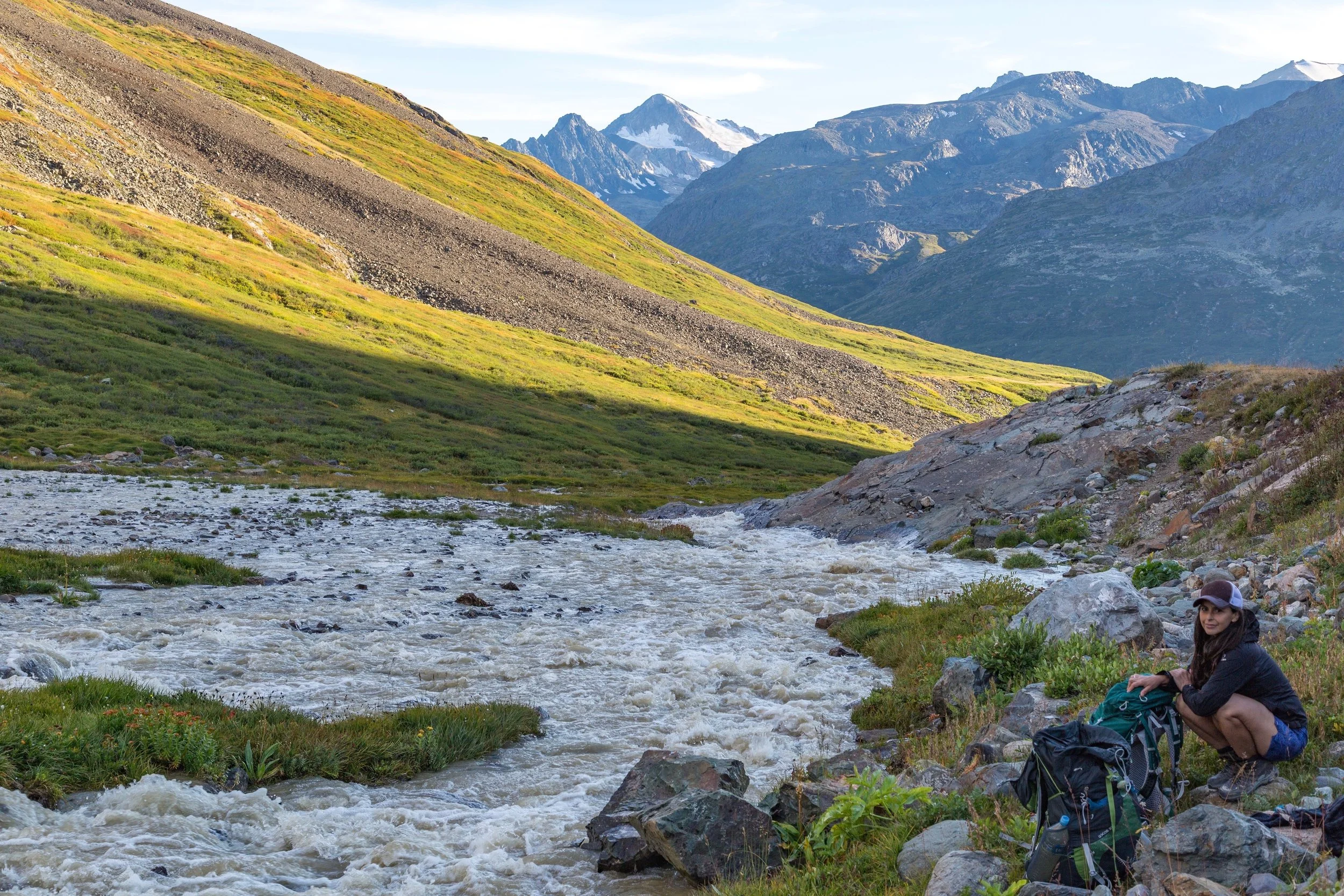
In the photograph above, taken at around 2, 600 metres in the Tavan Bogd National Park, in Mongolia, I am feeling both calm and fulfilled. We had just crossed the river I am squatting next to. For over an hour prior to crossing I walked up and down the bank on the other side looking for stepping stones to cross over its roaring, opaque, glacier-cold water. There were none. The inevitable dawned and my heart beat faster - I was really scared. Boots had to come off and we would have to wade across, unable to see the rocky, slippery, bottom and endure the thigh high freezing water. My travelling companion and I unclipped our packs, hung our boots over our necks and with socks on our feet, we held hands and slowly made our way across. On the other side we both cursed loudly at the stabbing cold in our feet, but as the circulation returned to our lower limbs the feeling of having overcome a fear filled me with confidence and joy.
Hiking in Mongolia was spectacular, I am excited about our first major overseas walking expedition there next year. I am also excited about the next 6 months in the southwest and all our walks and retreats here.
At the same time, I am fearful, fearful that although I am confident about hiking and creativity, I do not know enough about tourism to take Edgewalkers to the next level! Fearful that I do not know enough about marketing and selling to actually get people to book into retreats and walks; fearful that I will not make the most of the season; fearful that I will look like a fool!
Fear
Perhaps the most insidious resistance to embracing creativity is the fear of being ridiculed by those around us. Thinking creatively can make us aware of things/patterns/possibilities we had not previously noticed forcing us to take (or NOT) certain actions that might disrupt our lives, alarm our loved ones or appear irrational to the rest of the world. Yes, there were many questions asked when I first talked to friends and loved ones about my idea to run walking tours and creativity retreats!
We all have ideas, all the time. How many of us have looked at paintings and thought, gee, with some basic drawing classes, I reckon I could do that! Or, my life is so interesting someone should make a movie out of it! Or drank a fresh juice at an expensive eatery and thought, damn, my orange, grapefruit, turmeric and lime juice is so much better than this, I should start a business! If you embraced creativity and started to notice opportunities, embrace artistic impulses and start, as Madeleine L’Engle put it, disturbing the universe, you never know what could happen…and that freaks us out!
What if what we try doesn’t work and it ends up being rubbish? Somehow it seems better to just stay safe & comfortable and keep telling ourselves: “I don't have a creative bone in my body!” or my favourite: “I’m too old to go in that direction now, this is what I know, I’ve trained and studied and am experienced in this, I can’t suddenly become a beginner in that!
Julia Cameron who wrote The Artist’s Way, a useful creativity recovery program, has a great response when people ask:
“Do you know how old I’ll be by the time I learn to play the piano, guitar, saxophone, sing, draw, cook, dance, program computers, design furniture, write songs, make airplane models, do stand up comedy, make films, take good photos …(insert any number of possibilities here)?
She tells them:
“Yes… the same age you will be if you don’t!”
Isn’t that a fact?!
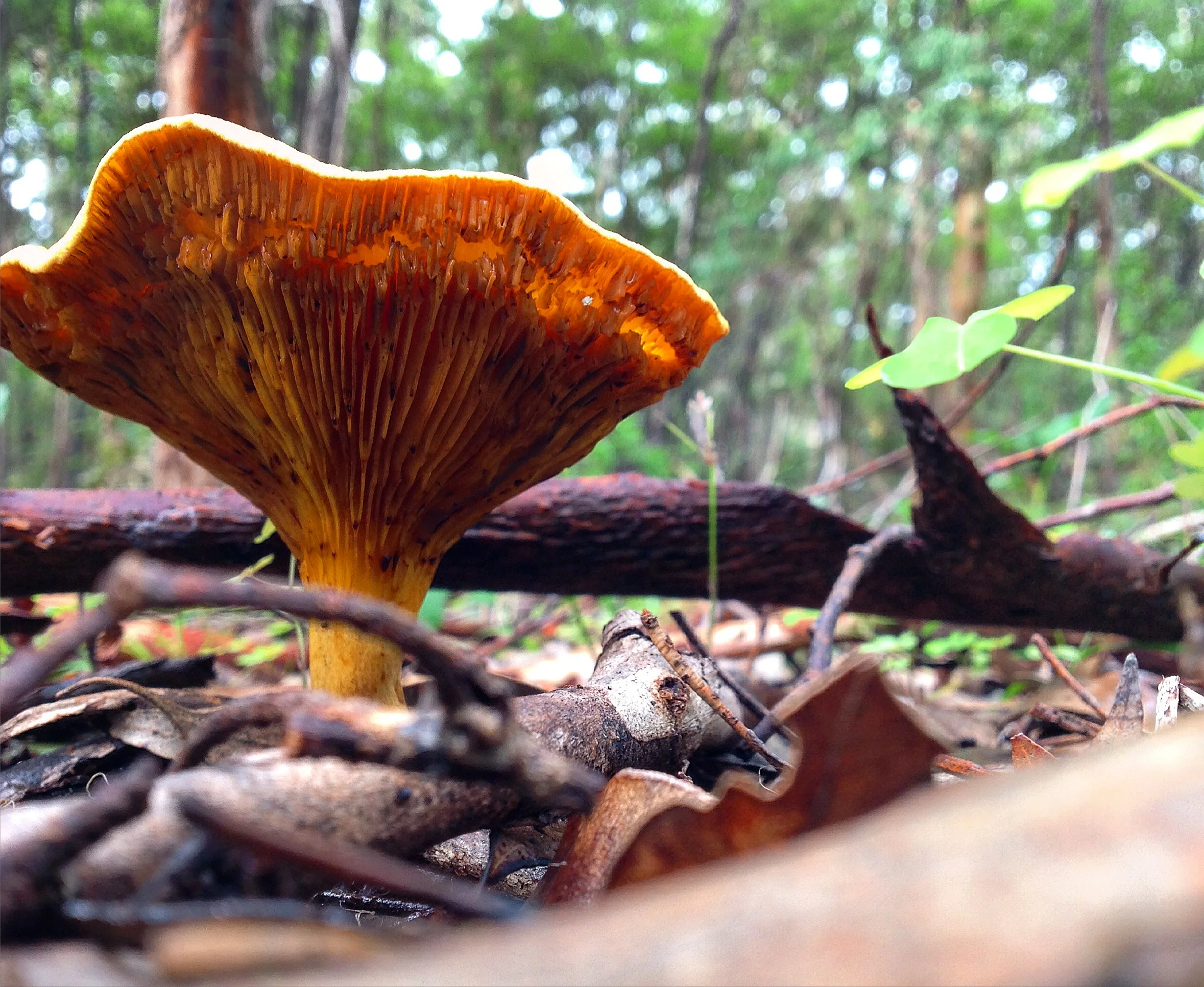
Austropaxillus infundibuliformis Boranup Forest - Margaret River
When it comes to flora, Australia’s southwest is one of the most bio-diverse regions in the world, and is especially renowned for its wildflowers. What many people do not realise, and I was not completely surprised to learn, is that there is even more diversity when it comes to fungi species. The region is a mycologist’s paradise with fungi of all sizes, shapes, colours and functions to be seen throughout the southwest.
Fungi are an integral part of the forest environment so a particularly perfect place to see them here in the southwest is among the ground leaf, twigs and bark litter of Boranup Karri forest, just south of Margaret River.
These are the fungi captured during an 8 km walk starting on the coast at Cape Freycinet goes east through the coastal heath and circles through Boranup forest, follows part of the Cape to Cape track south and heads back around westwards to the coast -see below for details.
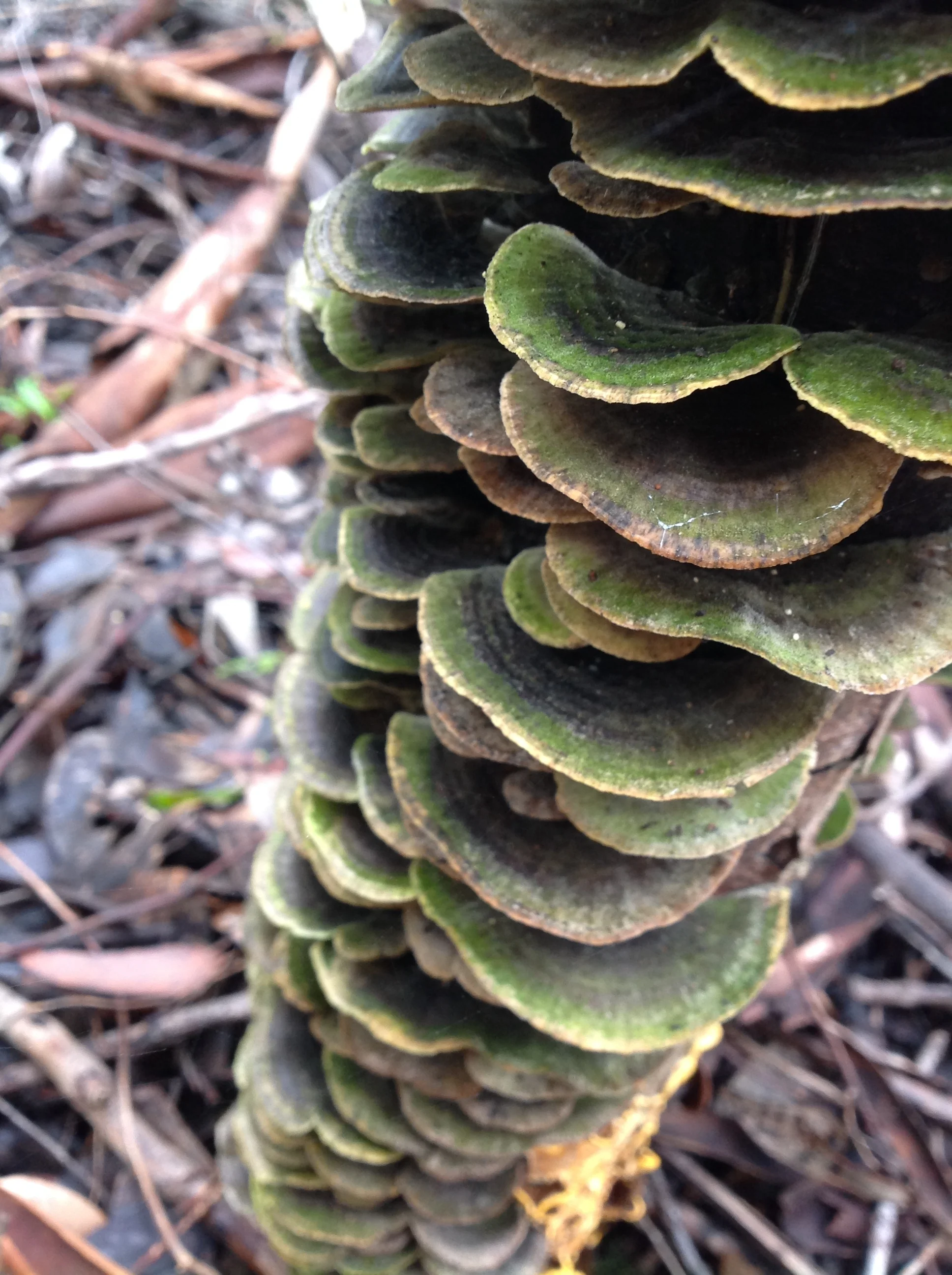
bracket fungi
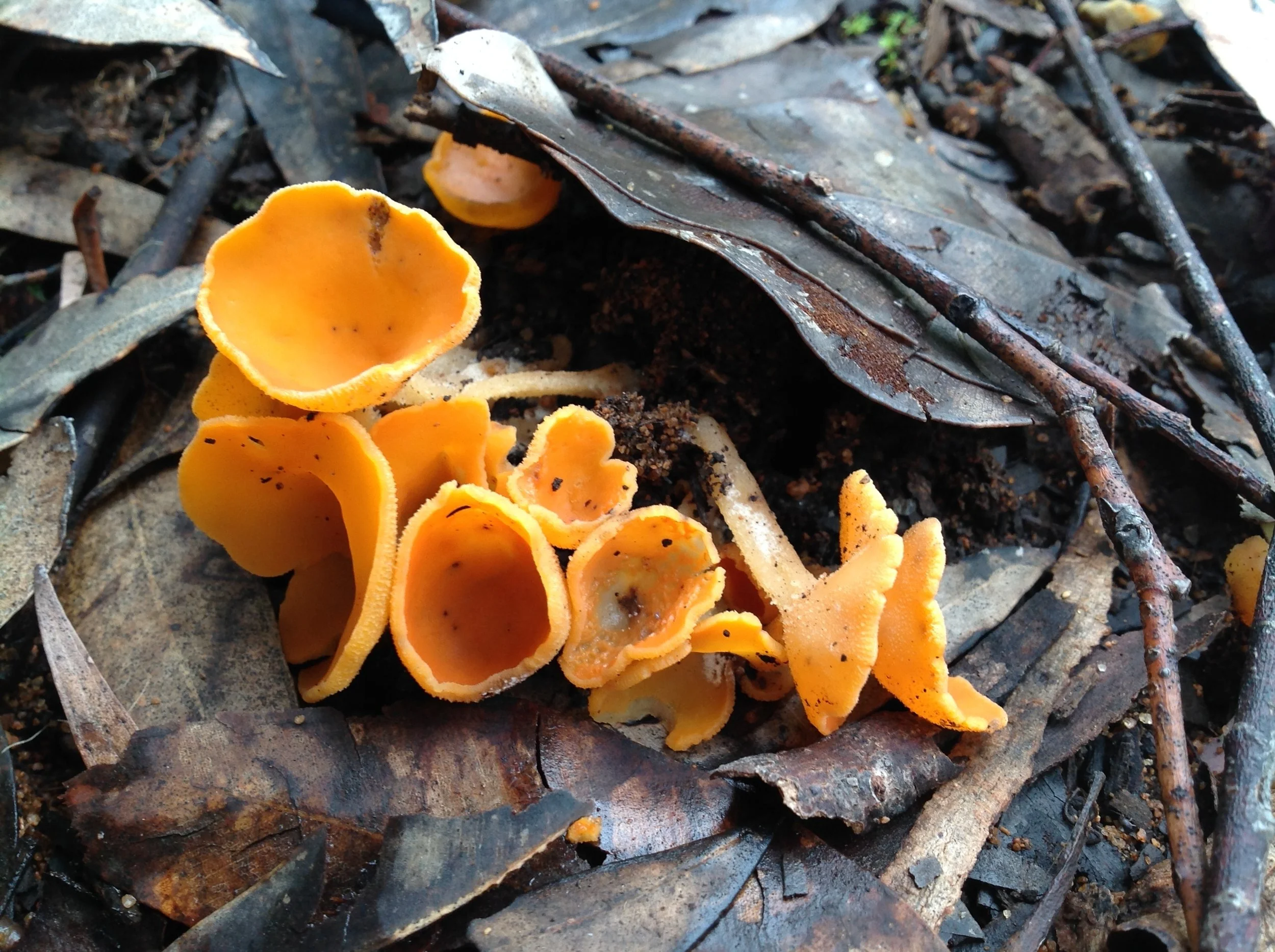
Aleuria aurantia, Boranup Forest, Margaret River
Fungi are not like plants, they cannot make their own food, and must feed either dead material or living organisms. They can be classified according to how they obtain food:
- Saprophytic – these fungi feed on dead organisms and release nutrients into the environment. They perform the important process of decomposing lignin, the hard substance in the cell walls of wood that would otherwise take a long time to break down.
- Symbiotic – these fungi live on living organisms either in a mutually beneficial relationship, or as parasites.
In a mutualistic relationship fungi take sugar from their hosts but provide them with water, phosphate and nitrate compounds. I was surprised to learn that 80 to 90 % of land plants could not survive without this mycorrhizal relationship with fungi.
In a parasitic relationship fungi harm their host or kill it. Dieback disease affecting parts of Australian Eucalyptus forests is a parasitic fungus. But they are also important because they contribute to biodiversity by preventing species from becoming dominant.
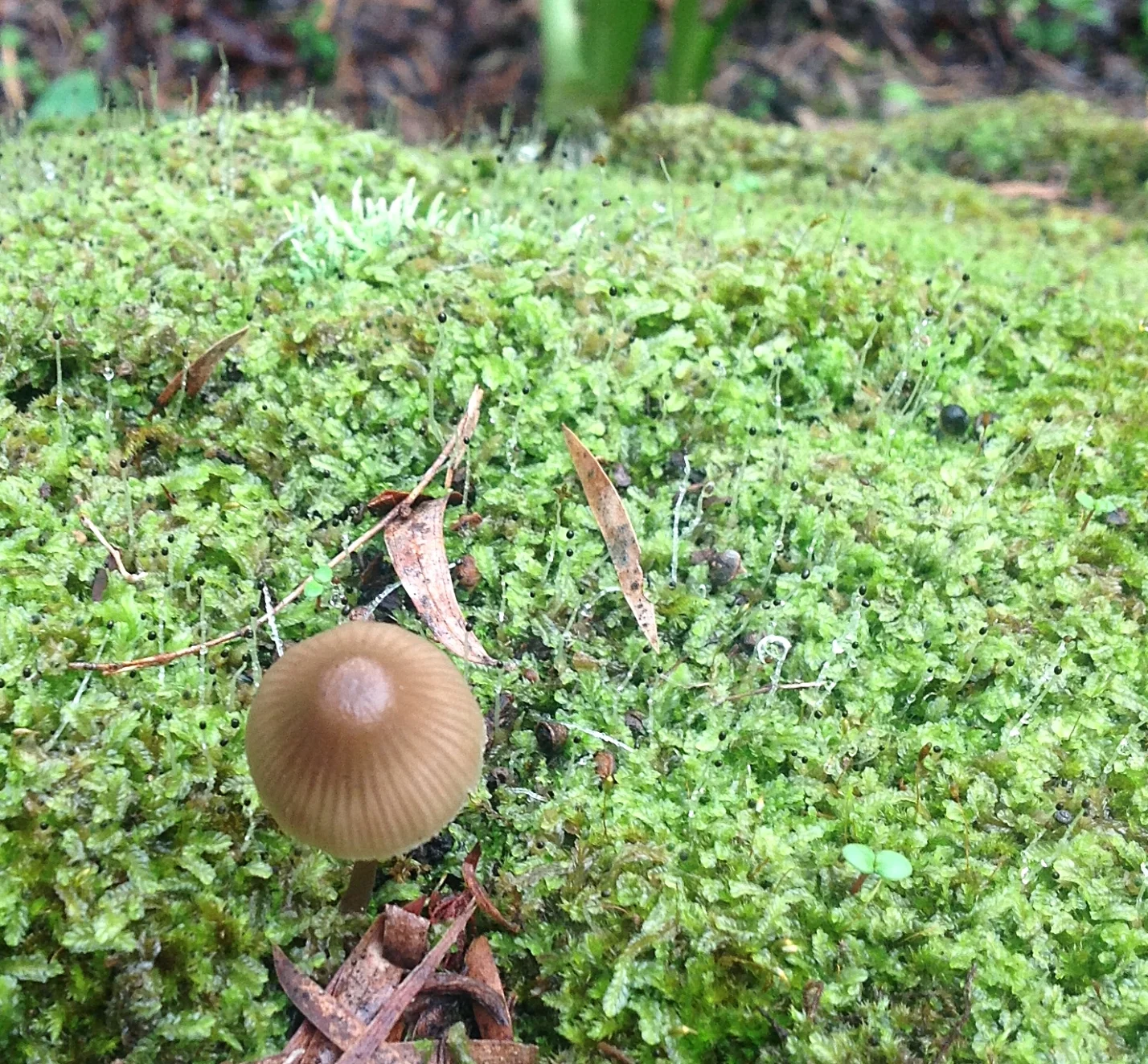
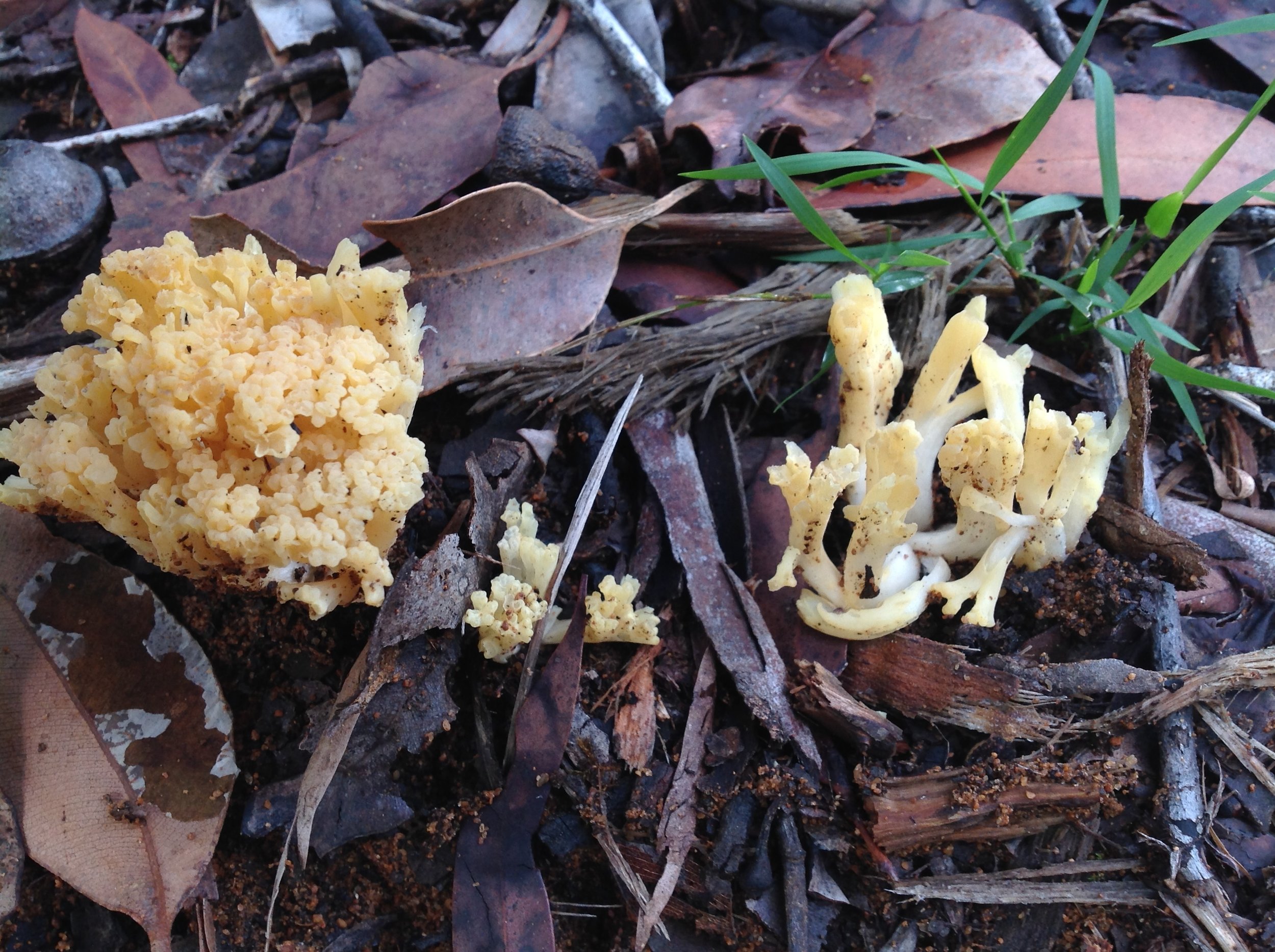
Ramaria ochraceosalmonicolor - Boranup Forest, Margaret River
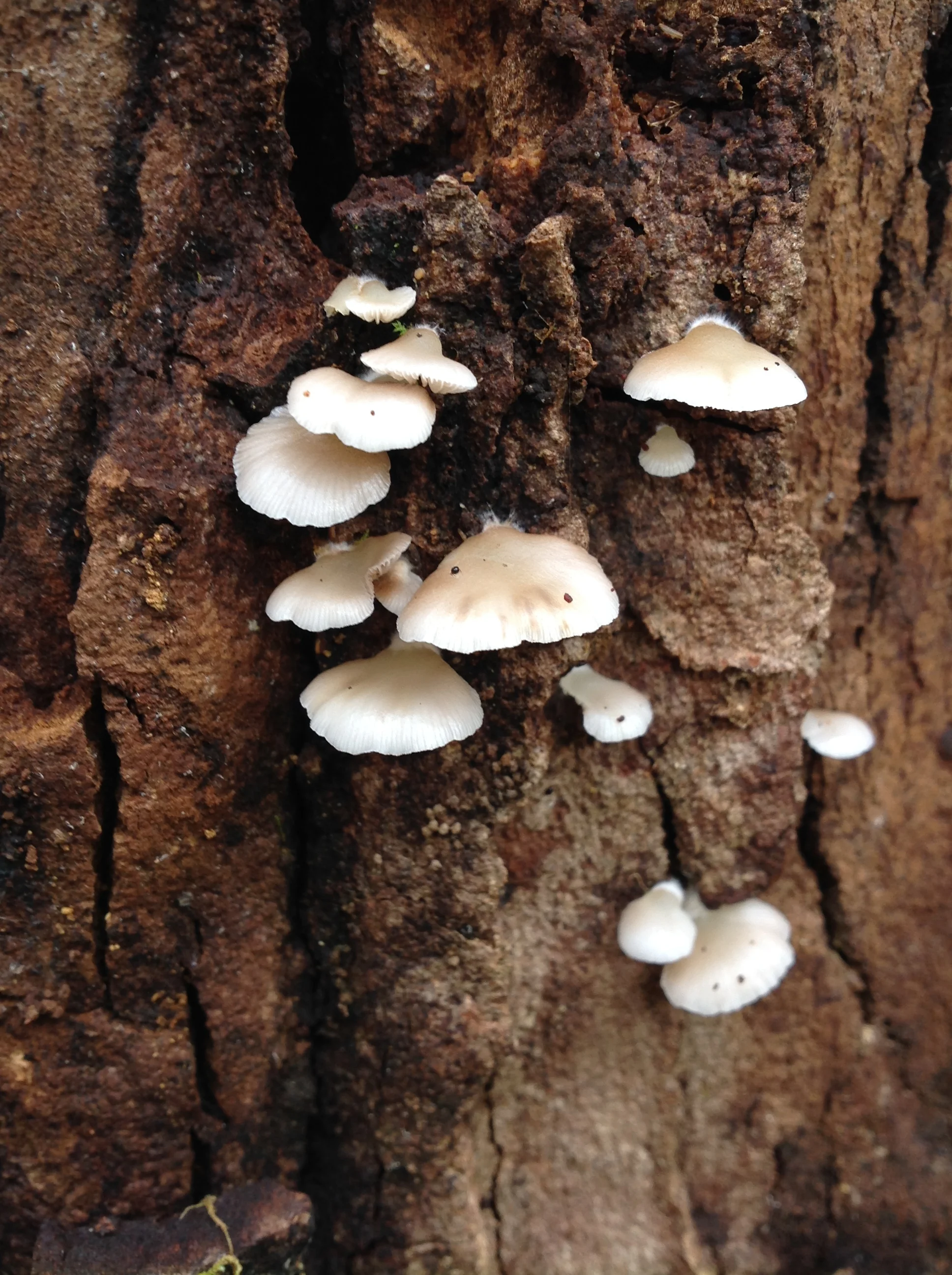
Crepidotus nephrodes, Boranup Forest, Margaret River
‘Fungi are the grand recyclers of the planet and the vanguard species in habitat restoration’
Paul Stamets
According to Dr. Paul Stamets, a prominent American mycologist, mycelium holds the key to solving many of the environmental issues we face today.
While there are a number of eye-opening and riveting talks by Stamets on YouTube, in this TED Talk he summarises some of his key ideas including some of the properties, capacities and possibilities that he thinks make fungi instrumental in helping restore the planet.
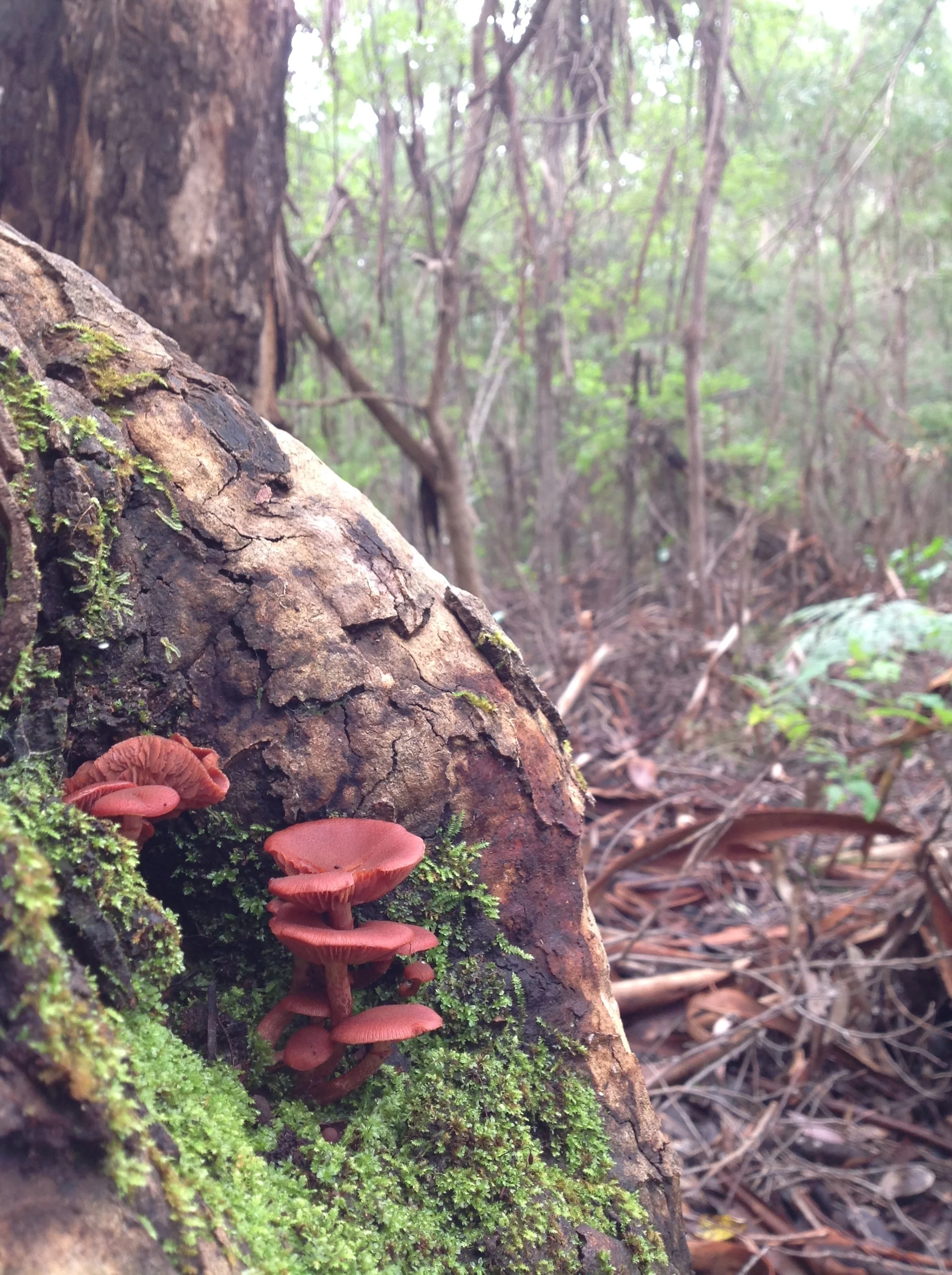
Tree fungi, Boranup Forest, Margaret River
Here are two resources worth visiting for more information on local southwest fungi.
Negus, P. and Scott, J. (2006). The Magical World of Fungi. Cape to Cape Publishing, North Fremantle.
Robinson, R. (2003). Fungi of south west forests. Department of Conservation and Land Management, Kensington.
Start at South Beach Car Park in Cape Freycinet at the end of Conto road which you can access from Caves road as you head south from Margaret River. Park and walk back up the hill (northward) along Conto road and turn right at Point Road (east). As soon as you enter the canopy of the Marri trees that line this 4WD track you will start to see varieties of fungi among the ground litter of leaves and twigs and growing on the mossy bark of fallen tree trunks.
Walk along Point Road past the campground until you reach Georgette Road where you turn right again (southeast) and follow the Cape to Cape track to the top of the hill. The Cape to Cape track veers to the left (east) on Brozie Road, we turn right (west) back towards the coast. The total distance is about 8 km.
If these instructions are not clear enough just buy the book, it's only $25 dollars - I can't recommend it enough!
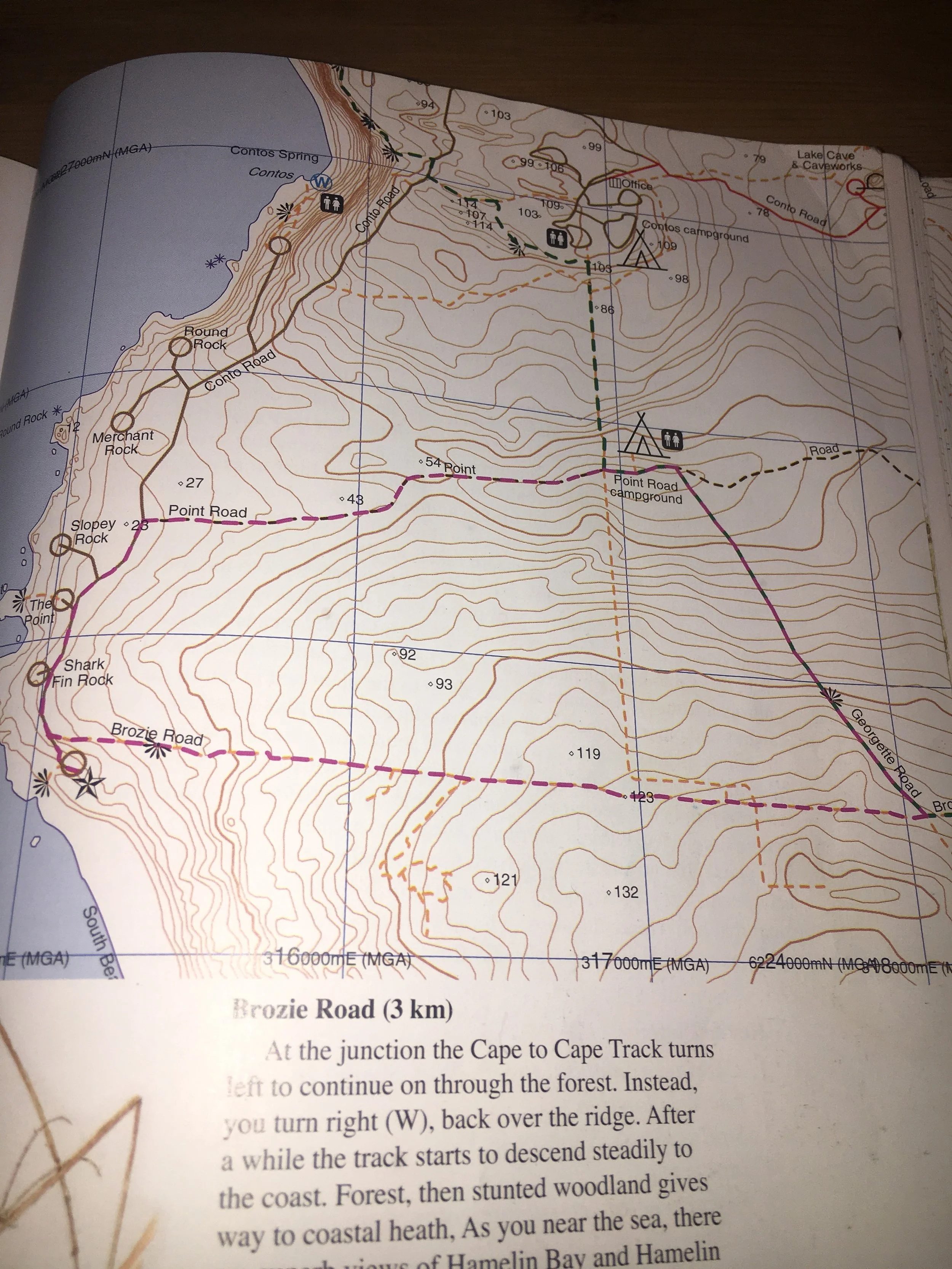
This is a picture of map #16 straight out of Walking Round in Circles by Jane Scott and Pat Negus, a wonderful collection of 27 circular walks in the Leeuwin-Naturaliste National Park.

Perhaps the most insidious resistance to embracing creativity is the fear of being ridiculed by those around us.
Why would you want to think creatively when thinking creatively might make us aware of things/patterns/possibilities we had not previously noticed forcing us to take (or NOT) certain actions that might disrupt our lives, alarm our loved ones or appear irrational to the rest of the world?
We all have ideas, all the time. How many of us have looked at paintings and thought, gee, with some drawing classes, I reckon I could do something like that! Or, my life is so interesting someone should make a movie out of it! Or drank a fresh juice at an expensive eatery and thought, damn, my orange, grapefruit, turmeric and lime juice is so much better than this, I should start a business! If you embraced creativity and started to notice opportunities, embrace artistic impulses and start, as Madeleine L’Engle put it, disturbing the universe, you never know what could happen…and that freaks us out!
What if what we try doesn’t work and it ends up being rubbish? Somehow it seems better to just stay safe & comfortable and keep telling ourselves: “I don't have a creative bone in my body!” or my favourite: “I’m too old to go in that direction now, this is what I know, I’ve trained and studied and am experienced in this, I can’t suddenly become a beginner in that!
Julia Cameron who wrote The Artist’s Way, a useful creativity recovery program, has a great response when people ask:
“Do you know how old I’ll be by the time I learn to play the piano, guitar, saxophone, sing, draw, cook, dance, program computers, design furniture, write songs, make airplane models, do stand up comedy, make films, take good photos …(insert any number of possibilities here)?
She tells them:
“Yes… the same age you will be if you don’t!”
Isn’t that a fact?!
We loved putting paint on the blank canvasses with Rebecca Cool at the last Edgewalkers Creativity & Walking Retreat in Margaret River
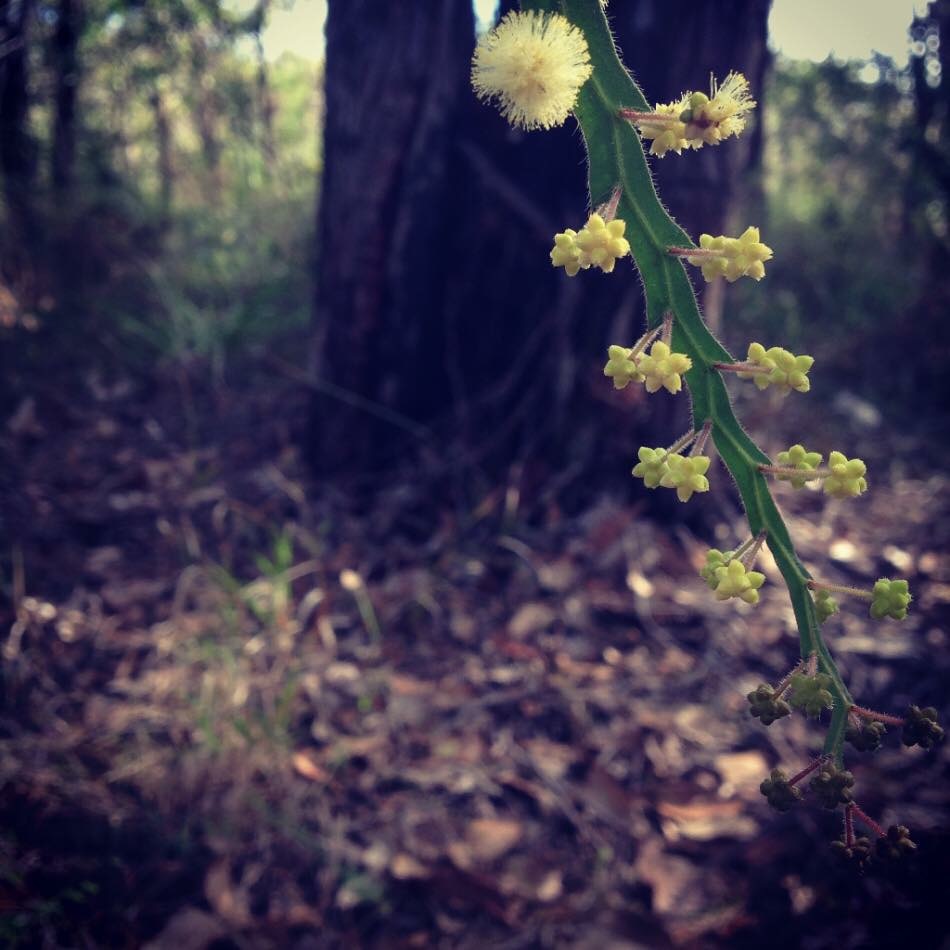
Acacia alata - Winged Wattle - the fourth species of wattle in my wildflowers lexicon.
The first time I walked on the Cape to Cape, a 135 km coastal track here in the Margaret River region of Australia’s southwest, I felt like a curious child who is learning to read. A child that has only learnt consonants and vowels but not quite how to put them together. Illiterate, I wandered fascinated and wide-eyed in a world of colours and shapes: red bells, orange peas, blue fans, whites stars, yellow orbs. Over time, and armed with a copy of Wildflowers of Southwest Australia written by Jane Scott (and perfectly illustrated by Pat Negus), I started to build my vocabulary.
For example, one day the ubiquitous, fluffy ‘yellow orbs’ went from being ‘fluffy yellow orbs’ to being acacias and wattles. Just like that my walks became red bells, orange peas, blue fans, white stars and… Acacias.
Then I noticed that the Acacias that were knee high along the trail had leaves that looked like ivy. Another time I observed that the Acacias that lined a path near the river in Augusta had lots of small thorns. Some weeks later, on looking closer, I saw that some Acacias, the ones that were taller than me, dropped thousands on black seeds encased in a red woody ring.
Suddenly my walks were a world of red bells, orange peas, blue fans, white stars and Shark’s Tooth Wattle (Acacia littorea), Prickly Moses (Acacia pulchella) and Red-eyed Wattle (Acacia cyclops).
Last Christmas I bought a copy of Noongar Bush Medicine - Medicinal Plants of the South-West of Western Australia by Vivienne Hanson and John Horsfall. It records the various uses of plants by the traditional Noongar elders and healers of the region.
A few days ago I was walking along this enchanting coastal ridge, between Moses Rocks & Qinninup Falls, when I noticed the wattles were already starting to flower. I stopped and delightedly pointed that out to my (amused) visitor. She listened as I told her that in Noongar language these Red-eyed Wattles, or Acacia cyclops are called Woolya, and that the juice from the leaves was traditionally used to receive eczema, repel insects and protect from sunburn.
I am now like a child that has learnt to recognise lots of words and can make simple sentences. I walk along the Cape to Cape a little excited at every opportunity I get to name something; thrilled every time I recognise a word from my growing lexicon; humbled, and inspired, by the realisation that there is a lifetime of learning - and walking - ahead.
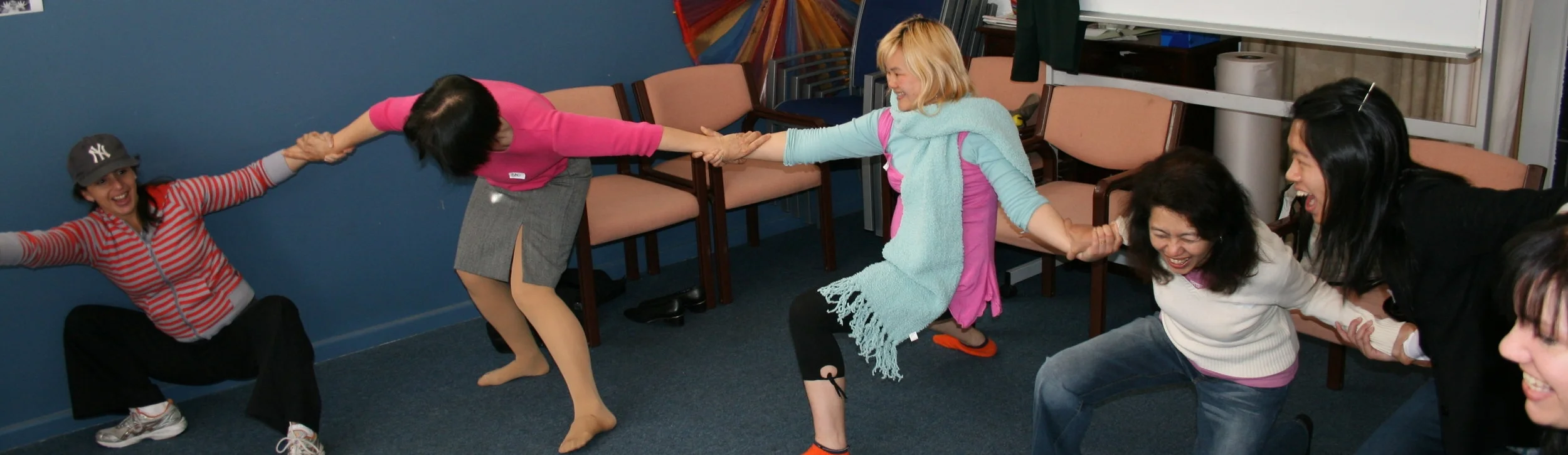
I have been asked to explain exactly what we will be doing during the Creativity sessions during the Creativity & Walking Retreats – here is an explanation.
We will be using a number of embodied applied theatre techniques borrowed and adapted from the work of Brazilian social theatre practitioner Augusto Boal. As well as warm up exercises and Image work we will be using a technique called Cops in the Head. Let me explain:
During the warm up we use a number of exercises that awaken different sensory sensitivities.
These exercises stimulate the sense of touch by awakening the feeling of what we touch. Similarly, they challenge ways of moving that are mechanized, bring up emotions that are not externalized and offer new ways of using muscles and expressing. Different parts of the body are disassociated from each other and cerebral control can be exercised over all muscles, no matter how small
These activities aim at recreating ways of listening and finding ‘inner rhythms’ to avoid stereotyping people and characters. Rhythms can sometimes represent emotions better than words and faces.
During these activities sight is denied to enhance other senses and what they perceive.
These include mirrors and physical sculptures to help us to see what it is we see. These must be done in silence in order for the dialogues to be richer and deeper.
These activities aim at reconnecting participants with memory, emotion and imagination
The above activities can also be used to draw parallels to our struggles and examine deeper what it is that is getting in our way. We will then use more involved image work in which, divided into groups, participants will discuss a personal experience relating to the struggle we are facing in sustaining, reconnecting or starting a creative practice. We will construct physical images of the struggle and as a group we will choose one particular scene to work on.
The Cop-in-the-Head (cops) technique will then be used to work more deeply and examine who (person) or what (convention, social rule, value) has ‘parked’ themselves inside our heads and whose internal monologue keeps us unable to move forward. As a collective we will all contribute to offering possible alternatives to enable the ‘blocked’ character to break through!
This is all SUPER FUN and PLAYFUL – you can contribute as much or as little as you like and you will find something useful – everyone does EVERY TIME!
If you would like to talk about this further please contact me erika@edgewalkers.com.au +61 (0)406758062 – I love talking about this – my (PhD) research into Transformative Learning centred on these techniques and on how to increase the transformative experience for participants – I LOVE this stuff – it is POWERFUL.
We will also use mapping, drawing, and a number of other creative thinking tools to enhance the workshops and access possibilities for transformation.
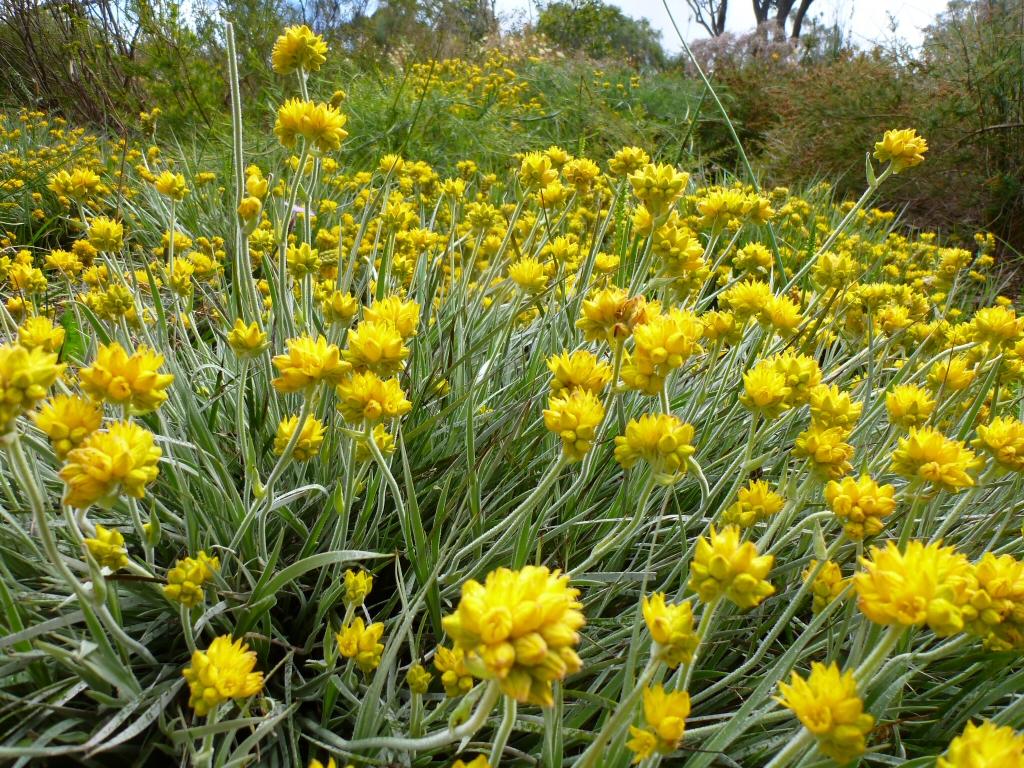
Photo credit: http://www.gardeningwithangus.com.au/conostylis-candicans-grey-cottonheads/
Flower essences were pioneered by Englishman Edward Bach in the 1930s. The development of other essences followed from the 1970s from countries such as Scotland, Australia and Alaska as well as the Himalayas. With Australia being abundant in plant species there are a couple of well renowned bush flower essence founders utilising Australian natives to create essences.
Usually the flower is selected to create an essence, however leaves and seeds can also be used.
A flower essence is the vibration of the plant infused in water. It is usually placed in the sun and/or moonlight for a few hours. Over the course of these hours the flower’s memory and vibration become imbued with the water. This becomes a mother tincture. Further dilutions are made before a person takes it as a remedy. As a remedy, plants can assist people (and animals) in various ways whether it be physical, emotional, mental or spiritual. In matters of health and health care settings the remedies are beneficial for calming, sexual misconduct, skin problems, cleansing/detoxification, working in areas of grief, emotional behaviours in general, as well as anxiety issues, relationship matters, dementia related issues and muscular aches and pains. The essences can be taken internally or mixed with creams, in water and blended together with essential oils.
A little while ago I had the opportunity to develop my own essence from a West Australian native called the Grey Cottonhead (Conestylis Candicans – eneabba form). Early benefits appear to be that it is physically energising (excellent in fact!), great for mental alertness and awareness of the ‘bigger picture’ and useful in communicating clearly.
From traditional bush medicine methods where by the plant was picked directly from the earth and its various parts used for healing purposes or to the modern day where plants are bottled, the purpose is still the same. It is nature offering humanity a healing gift. It is nature simply at its best.
Sana Turnock is Head of Academic Studies at the Australasian Academy of Wellness Therapies where she is a trainer, lecturer and assessor in clinical aromatherapy. She is an aromatic medicine consultant at Joyful Living Consultancy and will be delivering a workshop at the Women's Creativity & Walking Retreat in March. Her many publications are available at http://www.aromacasa.com/ Sana will be a regular contributor to the Edgewalkers blog bringing us latest research on native aromatic remedies and other therapies.